
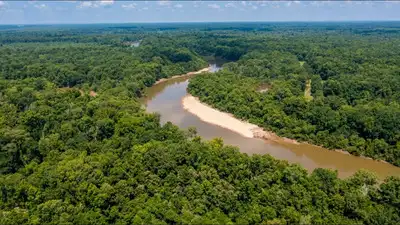
During the American Revolutionary War, Marion and his militia used the area’s remote swamps as a base for military operations
A 2,600-acre timber property in South Carolina, located near the rivers where Revolutionary War commander Francis Marion once hid from British forces, has been transferred to the state’s Department of Natural Resources. The land, known as River Forks, forms part of a larger 7,600-acre conservation project that aims to protect wildlife habitats, historic sites and areas that help reduce flooding. Flood protection is another major reason behind the conservation effort. The property contains extensive forested wetlands and floodplains that can hold large quantities of water during heavy rainfall.
The transfer, announced on Tuesday includes 11 miles of riverfront and marks the first phase of the Snow’s Island Assemblage conservation project, according to Vise Voter. The 2,600-acre River Forks property alone provides habitat for 140 high-priority conservation species, including 15 species listed as at risk under federal or state classifications. The Open Space Institute (OSI), a non-profit conservation organisation, transferred the property to the South Carolina Department of Natural Resources (SCDNR). The conservation project is intended to protect this historic landscape while eventually allowing people to visit the area. Once the land becomes part of the state’s Heritage Preserve and Wildlife Management Area programmes, visitors will have opportunities to explore the swamps associated with Marion’s wartime activities. The property, however, remains closed to the public while SCDNR works towards completing the larger conservation project. Among the wildlife associated with the wider conservation area are the Swallow-tailed Kite and Spotted Turtle. Protecting such a large stretch of connected land is intended to help animals move between habitats without the barriers created when natural areas are divided into smaller parcels.