
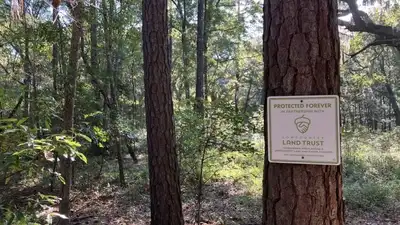
South Carolina will combine a 102-acre nature preserve with 50 affordable homes on Johns Island; hundreds of acres of green space are protected (Image Credit: Maddy Quon/Staff)
The land also carries a piece of Johns Island history
Lowcountry Land Trust points to maps dating to 1927 that identify the nearby Humbert Wood Public Elementary School. Charleston County separately approved $3.63 million in Greenbelt funding for the Humbert Woods project, with $1.2805 million in applicant matching funds. County documents identify 97.1 acres for protection and a 5.8-acre portion for a separate affordable housing project.
Preserving the surrounding landscape therefore also helps retain part of the area’s historical identity as Johns Island develops. The property has a cultural connection to the island as well as an environmental one. The school was associated with Mamie Elizabeth Garvin Fields, described by the organisation as one of the first African American public school teachers hired in Charleston County. She taught there early in her career. The project is not only about creating a new nature preserve; it is also about keeping a piece of the island’s landscape and heritage intact. The Humbert Woods project is being supported by several funding sources, including Lowcountry Land Trust’s Opportunity Fund, the Charleston County Greenbelt Program, the South Carolina Conservation Bank and the Charleston County Affordable Housing Land Acquisition Fund. The preserved portion is planned to include public walking trails, parking and picnic space.
Five acres will make room for affordable homes
The 102-acre Humbert Woods property will become a 97-acre nature preserve, while another five acres will be designated for affordable homes beside Sea Island Habitat for Humanity’s Sweetgrass Preserve neighbourhood, according to the Lowcountry Land Trust. The housing effort is planned as a 50-home community for local families earning up to 80% of the area median income. Before the conservation project, the 102-acre property was zoned for more than 30 homes, meaning residential development was already a possible future for the land. More than 97 acres contain upland forests and freshwater wetlands, according to the organisation. Sea Island Habitat describes Sweetgrass Preserve as a planned 50-home community consisting of one, two and three-bedroom homes for local families earning up to 80% of the area median income. Sea Island Habitat’s latest annual report says it surpassed its $4 million capital campaign target to fund Sweetgrass Preserve, the planned 50-home affordable neighbourhood. Only about 8% of Johns Island is permanently protected, while Humbert Woods is part of a network of other properties expected to become publicly accessible, including Grayson Oaks, Main Road Park, Simmons Creek and the Angel Oak Preserve. In a 2026 funding round, Charleston County approved more than $11.5 million for five projects expected to protect more than 900 acres countywide. Still, the basic division of the land is clear: roughly 97 acres are intended to remain protected, while a much smaller portion will contribute to an affordable-homeownership effort.
Because of its forests, freshwater wetlands and connection to other protected areas on Johns Island, instead, the Lowcountry Land Trust identified the property as a conservation priority.
The organisation says the homes are intended for working local families, including people employed in sectors such as hospitality, retail and service industries. Habitat homes are not free and that affordability comes through no-profit, interest-free loans and volunteer contributions, according to the Sea Island Habitat’s programme. Lowcountry Land Trust says the newly acquired property will expand the setting around the housing community and give residents access to nature close to their homes. Sea Island Habitat for Humanity says it is in the early stages of land planning for the homes, while the housing organisation and Lowcountry Land Trust are working together on plans for trails through the future preserve.
A new partnership on Johns Island, South Carolina, is bringing two pressing community needs together: protecting undeveloped land and creating affordable opportunities for homeownership. The wider Charleston County conservation programme is also protecting hundreds of additional acres beyond Humbert Woods. Humbert Woods is one of the largest remaining undeveloped parcels on northern Johns Island. Keeping most of the property undeveloped is expected to provide several environmental benefits. The land can support wildlife habitat, help improve water quality and store floodwaters, while also retaining part of the rural landscape that has traditionally characterised Johns Island. The plan also means the protected land will not simply be closed off from the community. Lowcountry Land Trust and Sea Island Habitat for Humanity are working on plans for trails that will provide public access to the future Humbert Woods nature preserve. Charleston County’s Greenbelt funding documents also describe walking trails, a small parking area and designated picnic space as part of the preservation plan. The other side of the project focuses on housing. Five acres of the Humbert Woods property have been designated for affordable homes next to the Sea Island Habitat for Humanity’s Sweetgrass Preserve neighbourhood. The broader goal is to make it possible for people who work in the area to also afford to live there. Habitat’s model is different from simply giving homes away. Its homeownership programme provides partner families with affordable housing through zero-interest Habitat mortgages. What makes the Humbert Woods project notable is the way the two goals are being planned together. Instead of treating conservation and affordable housing as competing uses of land, the partnership divides the property between them. Most of Humbert Woods will remain protected, while a smaller portion will support affordable housing alongside the planned Sweetgrass Preserve development. The organisations are also working together on the future trail network. For Johns Island, that balance is particularly relevant as development continues to change the area. The county’s conservation effort is much larger than Humbert Woods. That figure includes properties beyond Johns Island and should not be attributed entirely to the Humbert Woods project. The Humbert Woods partnership is still developing. For a rapidly changing Johns Island, the project offers a way to approach growth without treating new housing and open space as entirely separate priorities. The result is planned to be a neighbourhood where families can build homes while a large stretch of the surrounding landscape remains available for wildlife, conservation and public recreation. You use AI every day. Now get your AI Quotient. Take the AIQ test.