
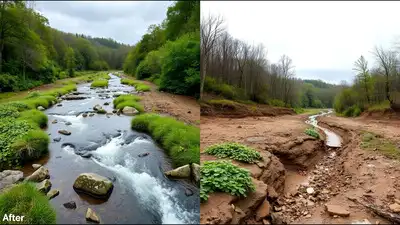
Representative Image of before-and-after views of Limekiln Brook, highlighting unpermitted work and its impact on the environment (AI Generated Image)
A 74-year-old homeowner in Bethel, Connecticut, has been ordered to either restore a brook behind his home to its previous condition or seek a wetlands permit for work he carried out there without approval. Mark Bjorken had moved rocks, reinforced sections of the banks of Limekiln Brook and built a bridge across the watercourse as he tried to protect his property from erosion, according to a September 13 report by the News-Times. Bjorken bought the single-family home on Rockwell Road about 10 years ago, and the brook runs so close to the house that he told the newspaper he can stand in his bedroom, open the window and fish. On September 10, Connecticut Superior Court Judge Barbara Brazzel-Massaro upheld the decision of Bethel’s Inland Wetlands Commission, finding that Bjorken had not established that his work was exempt from the town’s wetlands regulations. Judge Barbara Brazzel-Massaro ruled on September 10 that the commission had properly rejected Bjorken’s request.
The court therefore sustained the commission’s decision and dismissed his appeal.
The judge said the burden was on Bjorken to establish that the work performed in the wetlands area was exempt from the regulations, and concluded that he had not provided sufficient evidence to support that position. Bethel’s Inland Wetlands Commission rejected his request for an exemption. The commission’s records show that the matter involved unpermitted excavation or fill activity along and within the watercourse, and commissioners requested additional information during their review. A neighbour, Brian Blanchette, also participated in the proceedings as an intervening party and raised concerns about the work around Limekiln Brook. Bjorken subsequently appealed the commission’s decision to Connecticut Superior Court. His central argument was that the work should be treated as maintenance that did not require a wetlands permit. The town, meanwhile, argued that the work went beyond what could be considered exempt maintenance and that Bjorken had not provided enough evidence to establish that an exemption applied.
For Bjorken, the dispute is therefore not simply about a bridge or a section of eroding riverbank. As reported by the News-Times, he can restore the brook and the affected areas to their previous condition, or go through the town’s formal wetlands process and apply for a permit covering the work.
Bjorken told the newspaper that he was considering an appeal and said he wanted to protect his property from what he described as going “down the stream” as erosion continues near his home. The ruling leaves Bjorken with several possible next steps. He can also appeal the court’s decision. It concerns whether work intended to protect a private home can be carried out under a maintenance exemption or must first receive approval under Connecticut’s wetlands regulations.