
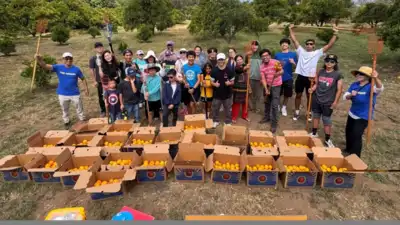
By August 2026, the initiative reported recovering more than 11,000 pounds of fruit through organised harvesting events. A California teenager has found an unusual way to tackle food waste and hunger by sending student volunteers into strangers’ backyards to harvest fruit that would otherwise go unpicked. Apollo Wong, founder of Glean On Me, started the initiative after noticing fruit rotting on neighbourhood trees while people at a local homeless shelter struggled to access fresh food. He began connecting homeowners with surplus fruit to charities that could distribute it to people in need. What started as a small community effort has grown into a student-led operation involving hundreds of volunteers across Pasadena and the San Gabriel Valley.
Wong founded Glean On Me in 2024 to put that idea into action. It had recovered more than 11,000 pounds of fruit by August 2026, according to the organisation’s reported figures. The initiative’s latest reported impact includes more than 250 volunteers, 24 harvesting events and partnerships with 14 organisations. Its website also reports that the recovered produce has helped nourish more than 6,100 people. The organisation estimates that its work has prevented more than 40,000 pounds of carbon dioxide-equivalent emissions. In 2025, Glean On Me was among the top five finalists in the Dragon Kim Foundation’s Dragon Challenge, which selected the project from approximately 600 applicant teams. The foundation also provided a $5,000 grant and leadership support to help develop the initiative. In October 2026, Wong was named a Daily Point of Light honoree for his volunteer work. He was also listed among the runners-up for the 2026 Gloria Barron Prize for Young Heroes, which recognises young people making a positive difference in their communities and the environment.
Because homeowners could not consume or harvest everything their trees produced, at the same time, he regularly saw fruit falling from trees in neighbourhood gardens. The name combines the word ‘glean’, which means collecting what would otherwise be left behind, with a reference to Bill Withers’ song ‘Lean on Me’. This is an estimate reported by the initiative, alongside its figures for fruit recovered and people reached.
Wong’s interest in fruit harvesting began during family gatherings at his Taiwanese grandparents’ home. His grandparents had a farm in Taiwan, and picking fruit from their backyard was a regular part of family celebrations, including birthdays and Lunar New Year. The idea for Glean On Me emerged later, when Wong was volunteering at a homeless shelter as part of his school’s community service requirements. He noticed the demand for fresh, nutritious food among people experiencing food insecurity. He realised that the two problems could be connected. Instead of allowing the surplus fruit to go to waste, it could be collected and delivered to organisations serving people who needed fresh produce. The initiative works by connecting homeowners who have excess fruit with volunteers and charities that can put the produce to use. Residents can register their properties with the organisation, allowing Wong to coordinate harvesting events when their trees are ready. Glean On Me has expanded considerably since its early harvesting events. For Wong, the project connects several parts of the community. Homeowners contribute their surplus produce, students give their time, and charities ensure the food reaches people who need it. Wong’s work has received recognition from several organisations. Now a high school senior, Wong is thinking about how the initiative can continue when he leaves for college. He hopes to pass its leadership to another person in the community while remaining involved in its summer activities. You use AI every day. Now get your AI Quotient. Take the AIQ test.
In the summer of 2025, Wong and his volunteers collected more than 5,700 pounds of fruit through 11 harvesting events. That effort involved over 100 student volunteers from 16 schools and supported eight local charities. He recruits mainly middle school and high school students, along with their families, to participate. Before each event, the team coordinates with the property owner and the charity that will receive the harvested fruit. The project has also expanded beyond individual residential gardens. Volunteers have participated in harvesting activities at locations including the Huntington Library and the Los Angeles County Arboretum, helping recover produce from additional properties. The fruit collected by Glean On Me is distributed through local charities, food banks and organisations that support people experiencing food insecurity. These organisations serve people and families facing difficult circumstances, including homelessness and financial hardship. The initiative has also worked with Food Forward, a nonprofit that recovers surplus produce and distributes it to hunger-relief organisations. Such partnerships allow the volunteers to connect their harvests with established food-distribution networks rather than having to organise individual deliveries to every recipient. The aim is to move the harvested fruit quickly from the trees to the organisations that can distribute it. This helps ensure that produce collected during the events reaches people while it is still fresh. Glean On Me addresses an environmental problem alongside food insecurity. Fruit left unpicked eventually falls to the ground and decomposes, even when it is still suitable for consumption. By collecting surplus produce before it goes to waste, the initiative gives homeowners’ excess fruit another purpose. Wong has also highlighted the environmental consequences of discarded organic matter, including the methane emissions associated with decomposing food in landfills.
Earlier figures show how quickly the project grew. Among the organisations named in the project’s earlier reports are Union Station, Friends In Deed and Ronald McDonald House Charities.
During the harvests, volunteers pick ripe fruit from trees, collect it in containers and prepare it for distribution. Wong also guides younger participants, explaining where the produce will go and why recovering food matters for both the environment and people facing food insecurity. The initiative has turned an ordinary neighbourhood activity into a community effort. Homeowners get help collecting fruit they cannot use themselves, students gain hands-on volunteering experience, and local charities receive fresh produce for their beneficiaries.