
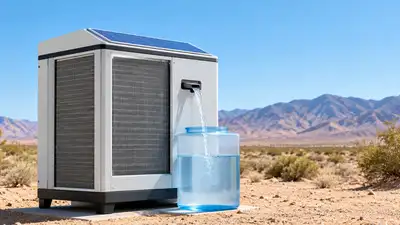
AI Representation: A device collects drinking water from dry desert air and fills a reservoir with fresh water. Image credits: Chatgpt
In the summer of 2023, scientists from UC Berkeley took a machine that could be held by two hands to Death Valley National Park in North America, which is one of the most arid and hot locations on the continent and allowed it to operate using only the energy of the sun. The findings, published in Science as Water harvesting from air with metal-organic frameworks powered by natural sunlight, reported a yield of about 2.8 liters of water per kilogram of MOF per day at relative humidity as low as 20 percent, using only sunlight to drive the release step; some press accounts described the same result as roughly 2.8 liters over a 12-hour test window, though the paper itself reports it as a daily figure. The 2023 Nature Water study notes that switching from zirconium-based MOF-801, priced at $160 per kilogram, to aluminum-based MOF-303, priced at $3 per kilogram, made the harvester far cheaper to build; the higher water yield came from MOF-303’s own adsorption behavior, not from its lower price.
It pulled water vapor out of the desert air, converted it to liquid and produced drinkable water without a battery, a plug, or any moving parts drawing outside power. The chemist behind the work, Omar Yaghi, had spent years building toward that single field test.
The Death Valley test was, by design, a proof‑of‑concept prototype rather than a final, household‑scale product. The scientists pointed out that the tiny size and limited daily amount of water provided by the device were more appropriate for proving the concept behind the chemical reaction rather than for providing enough drinking water for a family’s daily needs. Yaghi also disclosed in a public interview that further development along the same lines of MOF chemistry greatly enhanced production, and his firm began manufacturing more efficient devices capable of producing water in quantities of dozens or even hundreds of liters each day.