
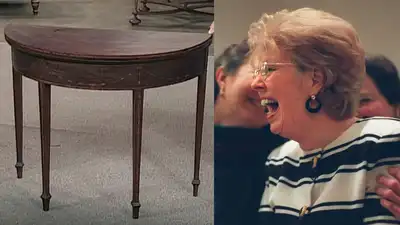
A New Jersey schoolteacher who bought a mouldy, pitch-black table at a garage sale for just $25 ended up owning a rare piece of American furniture worth more than half a million dollars. But when furniture expert Leigh Keno examined it in Secaucus, New Jersey, in 1997, he discovered an original maker’s label identifying it as the work of Boston cabinetmakers John and Thomas Seymour. The table was later sold at Sotheby’s for $490,000, with the buyer’s premium bringing the total to $541,500.
Claire Wiegand-Beckmann purchased the table roughly three decades before it appeared on Antiques Roadshow, when she was moving into a new home and wanted a small table. She initially saw little reason to believe it was valuable.
The seller had priced it at $30, but Wiegand-Beckmann said she had only $25 with her.
She told Antiques Roadshow that she needed a small table and thought the piece might work for the space. She recalled that it was “pitch black” and “a moldy mess” when she saw it outside at the sale. Wiegand-Beckmann came across the table at a garage sale in New Jersey while she was moving into a new house. It was hardly an obvious treasure. The seller agreed to accept the lower amount, allowing her to take the table home.
The purchase was made roughly 30 years before her appearance on Antiques Roadshow. The turning point came in 1997, when Antiques Roadshow held an event in Secaucus, New Jersey. The table is dated to about 1794. When Keno examined the table in 1997, the initial auction estimate was $200,000 to $300,000. The appraiser suggested that on a particularly good day it could potentially bring $300,000. That was already an extraordinary increase from the $25 garage-sale price. PBS later updated the auction valuation for the piece to 400,000-600,000 in its records. The process eventually took it to Sotheby’s in New York, where it was offered as part of the auction house’s Important Americana furniture and folk art sale in January 1998. Bidding reached $490,000, at which point the table was sold, according to PBS’s later account of the auction. The $490,000 figure was the hammer price. Once Sotheby’s buyer’s premium was added, the total selling price reached $541,500. Wiegand-Beckmann had paid $25 for a table that looked dirty, damaged and unremarkable. The $541,500 final price, including the buyer’s premium, was 21,660 times the $25 that Wiegand-Beckmann had originally paid.
Because it was awkward and wobbly, Wiegand-Beckmann brought it into the event upside down on a cart. The original $25 purchase price therefore represented only a tiny fraction of what specialists believed the table could command at auction. Because labelled examples of the makers’ work were rare, keno specifically noted that the label was unusually valuable evidence. Because retaining its original finish helped preserve the characteristics that specialists valued, that proved significant. Because the table looked so ordinary when Wiegand-Beckmann bought it, the story has remained one of Antiques Roadshow’s most memorable discoveries.
Keno told Wiegand-Beckmann that the table was an exceptional example of Federal furniture. Wiegand-Beckmann told the Antiques Roadshow team that she had used linseed oil and turpentine on the table but did not refinish it. For years, the table was simply a piece of furniture in her Bergen County home. At the time she bought it, there was no indication that the seemingly battered table was a significant example of early American furniture. Wiegand-Beckmann decided to bring the table along to see whether experts could tell her more about it. The table reportedly arrived in an unusual fashion. That made the object look even less like an important piece of antique furniture. It was examined by furniture specialist Leigh Keno, who immediately began looking at its construction, decorative inlay and other characteristics. But one detail proved especially important: the table still had its original maker’s label. The label read John Seymour and Son, Creek Square, Boston. Keno explained that surviving furniture with an original label from the makers was exceptionally rare. Keno identified the piece as a Federal inlaid mahogany demi-lune card table made by John and Thomas Seymour, Boston cabinetmakers working in the late 18th and early 19th centuries. PBS classifies it as an 18th-century piece and identifies its material as mahogany. Keno highlighted its figured mahogany, satinwood inlay and distinctive decorative details as evidence of its quality. The Seymour name was particularly significant. John and Thomas Seymour were prominent Boston furniture makers whose work was produced for wealthy families of the period. The surviving label gave specialists an unusually direct connection between the table and its makers. Its craftsmanship, original features and maker’s label all contributed to its importance. The discovery transformed Wiegand-Beckmann’s expectations. The broadcaster also notes that valuations can change over time depending on market conditions and the circumstances of a sale. After the Antiques Roadshow appraisal, Wiegand-Beckmann contacted Keno about selling the table. The auction attracted collectors interested in American furniture. Bidding quickly moved far beyond the original estimate. The auction result was described by PBS as a world record for Federal furniture at the time. The transformation was extraordinary. Around three decades later, that same piece became a highly sought-after example of Federal-period American furniture. The difference between the purchase price and auction result was enormous. The table’s value was not simply a consequence of its age. Its rarity, original label, original finish, craftsmanship and association with John and Thomas Seymour all played important roles. One of the unusual aspects of the story is that the table’s battered appearance could easily have encouraged its owner to clean or refinish it extensively. Keno later explained that the table’s rarity, original label and original finish were among the factors that made it such an important piece. She had gone to a garage sale looking for a small piece of furniture, negotiated the price down to what she could afford and took home what appeared to be a battered old table. Instead, she had acquired a rare example of Federal-period craftsmanship by two important Boston cabinetmakers. You use AI every day. Now get your AI Quotient. Take the AIQ test.