
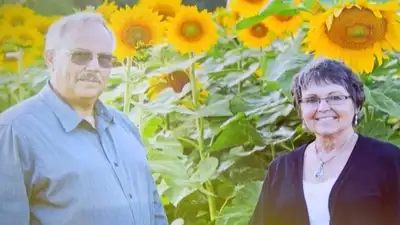
Don and Babbette Jaquish stand together in a sunflower field. Credit – wisconsinlife.org
The nonprofit had raised more than $50,000 for cancer research by 2018, showing how the memorial had grown into an ongoing fundraising effort, according to Wisconsin Life’s account of Babbette’s Seeds of Hope . In 2016, a sunflower maze created as part of the tribute attracted thousands of visitors, with donations supporting cancer research. What Don created in 2015 was more than a field of flowers.
Babbette’s original idea also involved using sunflower seeds to help others affected by cancer. She had understood the importance of cancer research and clinical trials through her own treatment, and Don later worked to turn that part of her vision into a charitable project. The family created Babbette’s Seeds of Hope, with the intention of selling sunflower seeds and directing part of the proceeds toward hospitals, cancer research and patient advocacy. The project gave the fields a purpose beyond remembrance: the flowers could generate support for people facing the same disease that Babbette had battled for years. The first harvest brought another emotional stage to the project. Once the bright flowers faded and the growing season ended, the sunflowers had to be harvested like an ordinary agricultural crop. Don used farm machinery to collect the seeds, which could then be packaged and sold. During the summer, the fields served as a giant memorial that filled the highway with colour; later, the same plants became a source of funds for the charitable purpose Babbette had imagined. The sunflower project expanded beyond Don’s original tribute. News and photographs of the enormous planting spread widely, bringing attention to both Babbette’s story and the charitable purpose behind the fields. People who had never met her could see the flowers and learn why they had been planted. For the Jaquish family, the response also showed how a deeply personal loss could become something that connected them with other families affected by cancer. The project continued in later years through Babbette’s Seeds of Hope. The sunflower fields became associated with seasonal events that allowed visitors to experience the flowers more directly. The family’s efforts eventually gave the memorial a recurring role in the community rather than limiting it to a single summer. Each new planting brought back the image that had become associated with Babbette and gave the family another opportunity to connect the flowers with cancer support. It combined Babbette’s love of sunflowers, her experience with cancer and her wish to contribute to research and patient support. The scale of the planting made the tribute visible from the highway, while the harvest gave the project a practical charitable purpose. The family continued the tradition in later years, keeping the connection between the flowers and Babbette’s memory alive.
Pingback: Deepak Ahuja, 60, and his wife Madhu Ahuja, 57, had travelled: The wider industry impact