
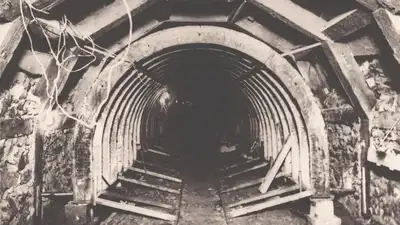
PC: American Society of Civil Engineers
The city appointed a board of civil engineers in September 1892 to develop a cohesive system. The mixed concrete flowed from a 6 in. pipe into a 6 in. rubber hose, and the teams communicated by a system of bells. Maniery wrote that an average of 32 batches per hour were placed even when the distance from the mixer to the discharge point was as great as 2,000 ft.
Nemo cites Carl E, according to the American Society of Civil Engineers. Grunsky, a former city engineer, who said that city officials and committees had pointed to the need for a comprehensive sewer system with increasing frequency before the earthquake. He described one spot, where sewage ebbed and flowed with no rain to dilute it during half the year, as a “filthy nuisance beggaring description”. Western Engineering (January 1915) reported an “average of 10 ft per day” at each end. The tunnel was the first successful application in San Francisco of pneumatic mixing and placing of concrete using compressed air, according to Maniery’s HAER report.
Grunsky recorded that sewers at the time emptied into San Francisco Bay wherever they reached the water. Miners and shovelers worked two eight-hour shifts at either end, and the third shift each day was for concreting. A compressor at the south end supplied the air, and materials were fed into a mixer at the tunnel adit.
Nemo reports that the final section, roughly 30% of the total length, required cut-and-cover construction through sand. Groundwater kept flooding the trench, so a layer of gravel was laid at the bottom and the water was directed to two sumps through a 10 in. underdrain. This removed 1.25 million gallons of water every day, according to the HAER report. On 26 August 1915, an inspection party that included Rolph, O’Shaughnessy and Muir drove a car into the tunnel. The tunnel went into operation by September 1915. By 2 March 1916, according to a letter from O’Shaughnessy to the Board of Public Works, only the filling of a shaft and some pavement restoration remained, and these were finished by early June.
A dragline excavator and a turntable derrick rig excavated a trench the width of the street above.