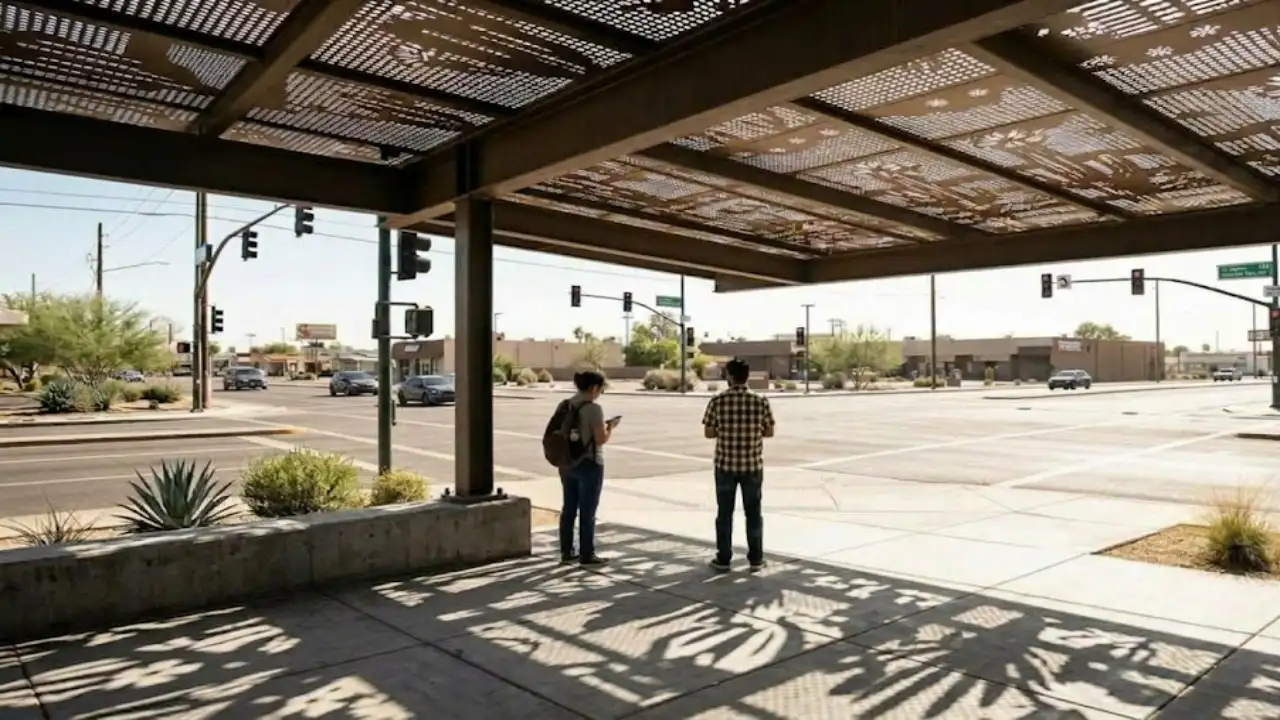
AI-generated representative image showing a desert-inspired shade canopy giving pedestrians relief while they wait at a crosswalk. Credits – Gemini
Three different shade designs were used, all inspired by the local desert environment. Two are variations on the saguaro blossom, one a single panel by artist Isaac Caruso, the other a multi-panel rendition by Heidi Dauphin with Studio Curiosity. The third is a butterfly design by Sara Altieri of Green Heart Creative Services. Each structure has its own look, shaped by the artists’ patterns etched in the roof panels and their choice of colour. The city’s location list identifies structures with concrete bases as well as structures without them.
Councilwoman Betty Guardado expressed disappointment that District 5 would receive only one structure. Air temperature may vary by only a couple of degrees between sun and shade, but physiological equivalent temperature, a measure of how hot conditions feel to the body, can vary by about 20 degrees in summer, said ASU urban climatologist Ariane Middel.
The project was funded with federal American Rescue Plan Act money, and Heat Response and Mitigation Director David Hondula said the funding requirements helped determine where structures could be installed. She said constructed shade structures work in ASU studies for regions where trees have a particularly difficult time growing and don’t need water. The project was not without its detractors. Shade science tells us the roofs are worth the effort. Air temperature doesn’t vary much between sun and shade, but what a body feels does.