
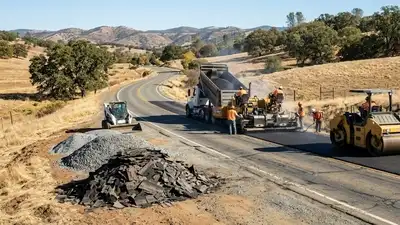
AI-generated representative image showing discarded asphalt roofing shingles being recycled into new asphalt pavement during a resurfacing project on a California highway. Credits – Gemini
California finally tried it in November 2021 . Crews paved four short test sections on State Route 49 in El Dorado County, in the Sierra Nevada foothills just south of Placerville. What went on the road Each of the four sections ran about 1,000 feet (roughly 300 metres) along a winding climb with sharp curves, and the old surface beneath them was far from perfect. A second used 10 per cent recycled asphalt pavement, the ordinary blend already used on the rest of the job. A third had 3 per cent shingles, and the fourth mixed 10 per cent recycled pavement with 3 per cent shingles, all assessed by the weight of the stone. Some 360 tons (approximately 330 tonnes) of each mix was placed on 2 and 3 November 2021, and the report states that there were no serious issues in production or paving. Further surveys were planned for 2026, and no results from them have been reported yet.
Because asphalt, the sticky binder that holds a road surface together, makes up 20 to 30% of a typical shingle, that is a wasteful practice. Because shingle asphalt is old and rigid, the contractor used a softer base binder in the recycled mixes and added a tall oil rejuvenating agent. Why shingles are a tricky component The researchers noted that the old road below was already damaged and reflected cracking was therefore always expected.
Since then, the road itself has told a more complicated story. Ten million tonnes of outdated asphalt shingles are thought to wind up in landfills in the US each year. Despite the fact that highway engineers had been aware of this for decades, the majority of agencies continued to exercise caution when installing crushed roof tear-offs on crowded public roadways. No one wants to learn that lesson on a state highway, where the wrong mix can lead to broken surfaces, early repairs and paying for the work twice. At the same time, researchers from the University of California Pavement Research Centre monitored the work for Caltrans. In their report, every mix submitted for approval and quality control, including those with ground-up shingles, passed the state’s two performance-related tests. That is a clear pass in the laboratory. Before paving, the road had fatigue cracking in the wheel paths, age-related transverse and block cracks, and asphalt that varied in thickness from place to place. Every part had a different recipe. One was a control mix containing no recycled material at all. It worked, perhaps a little too well. The binder in the shingle mixtures tested slightly stiffer than the contract called for at high temperatures, although the finished mixes still passed the state’s performance-related tests. That stiffness helps against rutting, but it is the kind of detail engineers watch when they think about cracking later on. They also suggest that pumping in the shingle-only section could speed deterioration by causing material loss from the layers below. One of the two shingle portions cracked less than a basic recycled mix, and a shingle mix can be produced, placed and approved under California’s performance criteria. The other showed the most distress of the four, and three years is a short time in the life of a highway. You use AI every day. Now get your AI Quotient. Take the AIQ test.
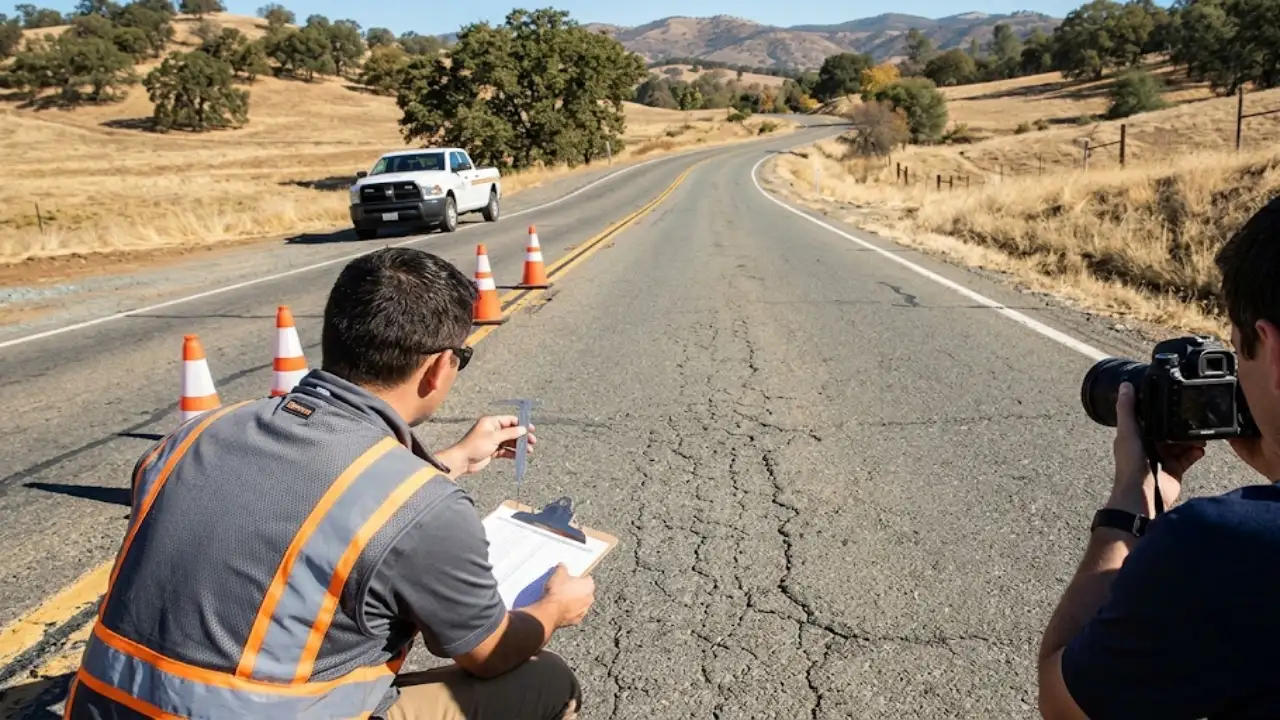
Earlier work by the same research centre had even reported poor results when shingle binder failed to blend with fresh binder, which was part of the reason for running a proper field trial. Laboratory results on plant-produced samples were mixed. In rutting tests on the mixes checked before construction, the control did worst, the shingle-only mix performed best, and the combined mix landed between them. Fatigue tests were split, with the shingle mixes doing better at higher strain levels and the control doing better at lower ones. Chemical ageing tests also suggested a higher risk of block cracking in the shingle mixes once their binder had aged heavily. AI-generated representative image showing researchers inspecting cracking and surface condition on an experimental asphalt road section several years after construction. Credits – Gemini Three years in service
Markets for recycled shingles are limited, according to a 2021 white paper from CalRecycle , the state’s recycling agency. It also points to the scale of the waste stream, with an estimated 687,155 tonnes of roofing shingles landfilled in California in 2018, which explains why the agency is looking for higher value uses. The Route 49 pilot went a step further by treating the shingle asphalt as part of the binder, which is why the mixes needed a softer base binder and a rejuvenator. A state contract was developed in 2007 to develop a draft specification that would allow up to 5% clean shingles in asphalt; however, no Caltrans district would execute a project and the contract was revoked in 2009. The four mixes later installed on Route 49 were only drafted by Caltrans in 2020 as part of the pilot specification.
Because oxidation makes the asphalt binder difficult to reuse, the paper says shingles in asphalt mixtures have mostly been used as a source of aggregate, not as a replacement binder,. The core problem is that asphalt exposed on a roof for years becomes oxidised, stiff and brittle. It adds that the state has already been studying these constraints in practice, and it frames recycled shingles as a limited feedstock rather than a direct binder substitute. That same report demonstrates how slowly the idea moved.
In December 2024, about 3.1 years after paving, UC Davis researchers closed a lane, walked the sections and recorded every crack. The mix with 3 per cent shingles alone showed the most wear, with low-severity alligator cracking along about 6 per cent of its wheel path, mild pumping of fine material through the cracks and slight rutting, the only section to show any. The combined mix of 10 per cent recycled pavement and 3 per cent shingles did far better, with alligator cracking along under 1 per cent of the wheel path, less than half the level in the section using recycled pavement alone.
A laboratory cannot fully copy snow, traffic and several summers of heat, so the real verdict had to come from the road. That runs against its laboratory result, where the shingle-only mix rutted least, and it is a reminder that plant-produced samples cannot capture everything a road goes through. The control mix had the least cracking overall.