
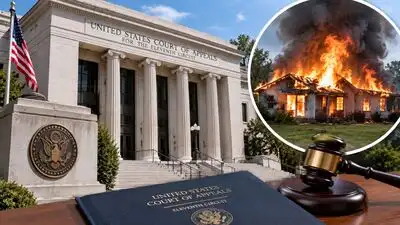
Image Credit: AI generated
What happened after the house caught fire
Despite both warnings, USAA General Indemnity Company issued a policy covering the house for $500,000. USAA General Indemnity Co., published on 11 August 2026, the dispute involved Dennis Renfroe and his daughter, Sherry Lambert, who jointly owned the property. Lambert had previously obtained a restraining order against her father and said they had not spoken outside court proceedings for 5 years. They were also involved in legal disputes over the Alabama property and a shared investment account worth $500,000. The jury awarded Renfroe $425,000. Following further proceedings, the district court reduced the amount to $226,727.85. In its 11 August 2026 judgment, the appeals court explained that Alabama law did not generally prohibit insurance policies from excluding coverage when an insured person intentionally caused a loss.
The legal dispute therefore centred not only on who might have started the fire but also on whether the policy allowed the insurer to refuse payment to an innocent co-owner. Because the insurer could still argue that Renfroe himself had caused the fire, however, it allowed the case to proceed to trial. The appeals court therefore held that the exclusion was enforceable under Alabama law.
According to the US Court of Appeals for the Eleventh Circuit’s ruling in Martin D. The insurer’s investigator considered the fire potentially deliberate, according to the judgment. An Alabama father and daughter warned their home insurer that they feared the other might deliberately set fire to their jointly owned property. The property in Centre, Alabama, burned down a few weeks later, leading to a dispute over whether the insurer was required to pay the claim. The case eventually reached the US Court of Appeals for the Eleventh Circuit, which ruled on the insurance policy and the company’s decision to deny coverage. Renfroe v. Their relationship had deteriorated over several years. A few weeks after the insurance policy was issued, the property burned down. Renfroe submitted an insurance claim, but the subsequent investigation did not establish who had started the fire. The insurer’s final investigative report did not rule out an accidental cause, although it concluded that the characteristics of the fire were consistent with arson. Both Renfroe and Lambert continued to accuse the other of responsibility. Renfroe admitted during the proceedings that two previous house fires had occurred. Lambert testified about three additional fires, including one at a former home she had shared with her father. USAA ultimately denied the claim, relying on a provision in the policy that excluded losses intentionally caused by any insured person. The provision also prevented an insured person who had not caused the fire from collecting if another person covered by the same policy had deliberately caused the loss. Renfroe sued USAA, alleging breach of contract and bad faith in the denial of his claim. The case was heard by a federal district court in Alabama. That court concluded that the policy’s innocent-insured exclusion was invalid under Alabama public policy. The district court also rejected Renfroe’s bad-faith claim, finding that the insurer had a legally sufficient basis to deny coverage. During the trial, both sides were permitted to present evidence suggesting that Lambert might have been responsible. However, USAA was prevented from relying on the innocent-insured exclusion as a defence. Both parties challenged aspects of the outcome. USAA argued that the court should have allowed it to rely on the policy exclusion, while Renfroe challenged the rejection of his bad-faith claim and the denial of prejudgment interest. The Eleventh Circuit disagreed with the district court’s conclusion that the exclusion violated Alabama public policy. It found no state statute or established court ruling that made the provision in Renfroe’s policy invalid. The court also noted that Alabama law specifically protects innocent co-insured people in certain cases involving domestic abuse. In its view, this exception demonstrated that the state legislature could prohibit such exclusions in particular circumstances. The policy itself included an exception for innocent insured victims protected by the Domestic Abuse Insurance Protection Act. This meant USAA should have been permitted to use the provision when defending its refusal to pay the claim. The ruling did not establish that either Renfroe or Lambert had started the fire. The appeals court separately upheld the decision to dismiss Renfroe’s bad-faith claim. It found that USAA had sufficient evidence to provide a reasonable basis for refusing the insurance payout. Other evidence included Lambert’s allegation that her father might have wanted the property destroyed so he could purchase the land more cheaply at the courthouse auction.
The court’s ruling also recorded evidence concerning earlier fires involving properties associated with Renfroe and Lambert.
Both parties raised concerns before the fire
In January 2020, before obtaining the insurance policy, Renfroe told USAA that he suspected his daughter was preparing to burn the house. The insurer subsequently issued a policy providing $500,000 in coverage for the house.
Lambert, meanwhile, said she had removed sentimental belongings after hearing that her father and her former husband were allegedly planning to set the house on fire. Lambert later contacted USAA after learning that her father had taken out the policy, according to the Eleventh Circuit’s judgment. Both wanted control of the property. The court’s account explained that their strained relationship had fuelled mutual suspicions about the possibility of arson. These concerns became central to the subsequent insurance dispute. He pointed to furniture being moved in and out of the property as a reason for his concern. Both Renfroe and Lambert were named as insured parties. She warned the insurer that she believed Renfroe was planning to burn the property and referred to what she described as his history involving house fires. Despite receiving warnings from both sides, USAA kept the policy in force. Cell tower records also suggested that Renfroe might have been near the property when the fire began. Renfroe’s former work as a pipefitter was relevant to the court’s consideration of that evidence. These findings did not amount to a definitive determination that Renfroe had committed arson. However, the appeals court concluded that the evidence gave USAA a sufficiently arguable reason to deny coverage, meaning its decision did not establish bad faith. The Eleventh Circuit vacated the judgment against USAA on the breach-of-contract claim and sent that part of the case back for further proceedings. You use AI every day. Now get your AI Quotient. Take the AIQ test.
Just two weeks before the fire, a state court had ordered it to be sold at auction, with the proceeds to be divided between them. Investigators further noted that a gas line connected to a space heater had been severed before the fire.