
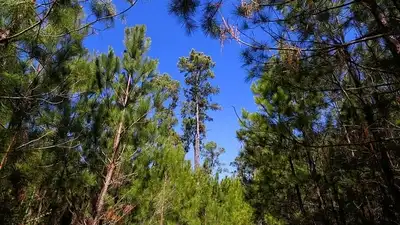
Towering loblolly pines (Pinus taeda). Image credits: Wikimedia Commons
A higher atmospheric CO2 experiment was conducted by The Duke FACE The Duke FACE facility was built in a loblolly pine plantation that was established in 1983. The elevated-CO2 lands were maintained at concentrations around 550-570 parts per million during the experiment, depending on the ambient conditions and the treatment protocol. Because localised soil conditions and resource constraints have a huge impact on how the trees synthesise the changed atmosphere from plot to plot, the experiment also showed why the average could not be interpreted as a universal response,. Therefore, the trees experienced higher carbon dioxide while continuing to grow in the open forest, with natural variation in temperature, rainfall, soil moisture and competition.
After nearly a decade of elevated CO2 exposure, the treated forest landscapes had accumulated around one-fifth more biomass on average. Loblolly pine (Pinus taeda) was the dominant tree, making the site useful for studying species widely distributed and commercially important across the southeastern United States. Rather than growing seedlings inside a greenhouse, researchers raised the carbon dioxide concentration around standing trees while allowing the forest to remain exposed to natural environmental conditions. The goal of the experiment was to see how additional atmospheric carbon affected biomass production, carbon storage, water usage and nutrient cycling. Those questions became increasingly important as scientists considered whether forests could absorb any of the additional CO2 entering the atmosphere from human activities. Furthermore, the experiment showcased the value of studying mature vegetation under open-air conditions, with the FACE technology allowing researchers to raise CO2 without sealing the forest inside an enclosure, thus preserving many interactions that occur in an actual ecosystem.
By 2007, researchers reported that after a study of over 10 years, the treated, loblolly-pine-dominated plots had produced around 20% more biomass on average than matched plots receiving ambient carbon dioxide levels. In 1994, a prototype FACE plot at Duke began receiving elevated CO2, while a completely replicated experiment began in August 1996 with three elevated CO2 plots and three controls. Following this, the facility later expanded to four elevated and four control plots that were described in Duke’s 2007 report.
Therefore, 1997 is associated with the four-plot configuration used in the long-term study instead of being the absolute beginning of CO2 enrichment at Duke Forest. In a forest outside Durham, North Carolina, Duke University spent over a decade testing a simple question: what happens when mature trees grow in air containing relatively more carbon dioxide than they normally experience? The long-running Free-Air Carbon Enrichment (FACE) experiment exposed forest plots to elevated carbon levels under open-air conditions instead of enclosing the trees in chambers.
Pingback: Carl Sandburg bought a 245-acre North Carolina estate for his wife's: The wider industry