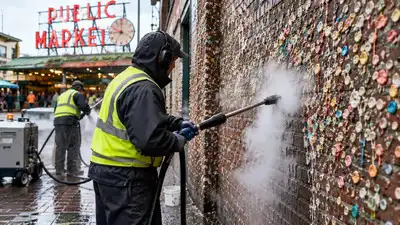
Representative image of workers steam-cleaning a brick wall covered with old chewing gum in a public market. Image Credits: ChatGPT.
By 2015, however, the colourful attraction had become more than a quirky tourist tradition. The great 2015 clean-up The clean-up began in November 2015, turning an attraction that normally drew tourists into an unusual maintenance operation. Pike Place Market later recorded that more than 2,000 pounds of gum were removed from Post Alley after roughly two decades of accumulation. Contemporary reports put the final amount at about 2,350 pounds, or more than a tonne of chewing gum. Officials treated the 2015 operation as a reset rather than a final closure. The rapid return of the gum became part of the wall’s identity, turning the 2015 removal into a temporary interruption rather than an end to the tradition.
Because the wall forms part of the historic Pike Place Market area, where preserving older building materials is a consideration during maintenance and restoration work, this was particularly important. The 2015 operation therefore became less a permanent end to the Gum Wall than a reset, removing decades of accumulated material while leaving the unusual tradition itself intact. TIME reported that a flash mob gathered at the newly cleaned wall, with visitors quickly adding fresh gum to the exposed brick.
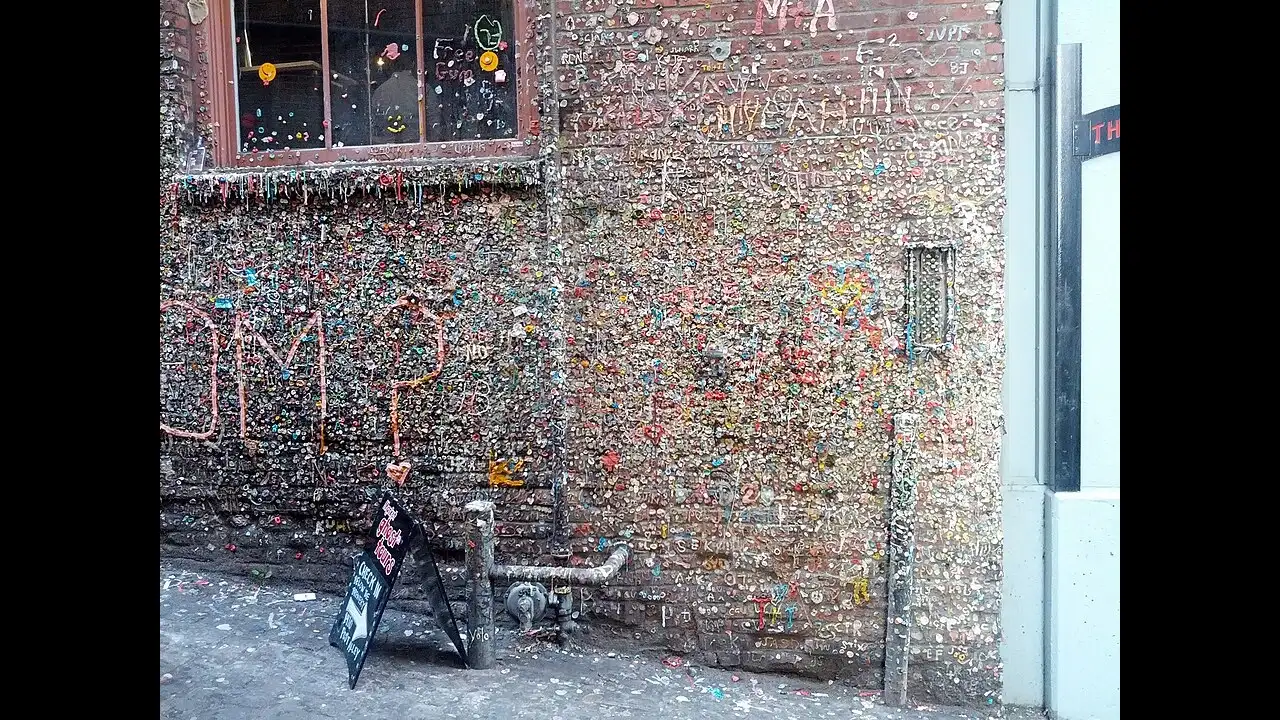
From theatre queue to tourist landmark According to Pike Place Market , the Gum Wall began in the 1990s when local patrons and performers at Unexpected Productions started sticking used chewing gum onto the brick wall in Post Alley. For years, visitors to Seattle’s Pike Place Market added their own small contribution to one of the city’s strangest landmarks: a wad of chewed gum pressed onto a brick wall. After roughly two decades of accumulation, the gum had formed a thick layer that officials feared could damage the historic brickwork. The solution was as unusual as the attraction itself: workers brought in industrial steam cleaners and stripped away the entire collection. The tradition began as a spontaneous habit among people waiting to enter the theatre, with some early visitors even pressing pennies into the gum. By the mid-1990s, the wall was already covered, and although attempts were made to remove the gum, visitors repeatedly rebuilt the display. Over time, what began as an informal act by theatre-goers developed into a colourful landmark, with thousands of pieces forming patterns, names and small artworks across the brick. Pike Place Market now describes the wall as a hidden work of art that continues to expand along Post Alley. The wall’s persistence was helped by the physical properties of chewing gum. Unlike many food residues, chewing gum does not readily dissolve in water or disappear after it is discarded. The gum base is formulated to remain elastic and cohesive during chewing, allowing discarded pieces to retain their structure after they are pressed onto a surface. As successive visitors added more gum, the older pieces remained in place and became part of an increasingly thick layer. What began as a handful of pieces left by people waiting for a show eventually became a wall-sized accumulation that was difficult to remove without specialised cleaning. Rather than scraping away the gum piece by piece, workers used an industrial steam machine to soften the accumulated mass so it could be removed from the brick. A small crew then collected the loosened gum in buckets. The sheer volume illustrated how dramatically the informal tradition had grown. Steam cleaning was used to loosen the gum without resorting to more aggressive methods that could damage the underlying masonry. Once the gum was removed, the brick wall looked almost unrecognisable. Yet the clean-up did not end the tradition. Visitors soon began sticking fresh pieces of gum back onto the exposed bricks, effectively restarting the landmark’s strange cycle. Pike Place Market’s Gum Wall in Seattle originated as a quirky theatre tradition back in the 1990s. Over the years, it transformed into a popular tourist site, attracting visitors eager to contribute their own chewed gum to the collection. Image Credits: Wikimedia Commons. The gum came back The market had no intention of permanently ending the tradition. Once the accumulated gum had been removed, visitors were allowed to resume sticking fresh pieces onto the wall. Within days, the colourful coating was already beginning to return. What had required industrial equipment and a major clean-up effort was recreated almost immediately by the public. Pike Place Market has since continued to manage the attraction through periodic maintenance. Steam cleaning is used to remove accumulated gum from the surrounding Post Alley walls and help keep the display within its designated area. The Gum Wall itself, however, remains part of the visitor experience. Each new piece added to the bricks continues a tradition that began as a spontaneous habit outside a theatre and eventually became one of Seattle’s most unusual landmarks. Catch the latest World News and Live updates. Download the TOI app.