
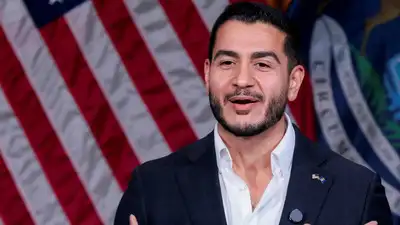
Democratic US Senate candidate Abdul El-Sayed
Abdul El-Sayed, the 42-year-old Michigan Democrat who defeated Republican Mike Rogers to make history, had a particularly choice message for Vance, who had spent the campaign attacking him.
“JD, habibi, there is this delicious irony in the fact that you’re constitutionally obligated to swear me in in January,” he told cheering supporters at his victory celebration, casually using initials for the vice-president and throwing in a snarky endearment – “habibi” in Arabic is “my love” For Trump, who had repeatedly struggled with El-Sayed’s name — at one point derisively calling him “Mohammed” — the incoming senator had an equally economical suggestion. The TOI correspondent from Washington: The first Muslim to be elected to the US Senate in American history wasted little time in igniting MAGA outrage, barely waiting for the confetti to settle before reminding President Trump and his veep JD Vance that they would have to get used to him. “Donald, look, I know you struggle with my name. So after JD swears me in in January, you can just go on and call me senator. El-Sayed, however, is about as American as they come. Born and raised in Rochester Hills, Michigan, to Egyptian immigrant parents, he grew up in the Detroit suburbs, captained his high-school football, wrestling and lacrosse teams, graduated from the University of Michigan, became a Rhodes Scholar at Oxford and earned his medical degree at Columbia University. His wife, Sarah Jukaku, is also American-born, to Indian immigrant parents with roots in Karnataka’s Bhatkal. A psychiatrist by profession, she and her family have given the Egyptian-American senator-elect a distinctly desi connection: El-Sayed has joked that after two decades of marriage, he might be more Indian than Arab.
Representatives Ilhan Omar of Minnesota and Rashida Tlaib of Michigan, both frequent targets of Trump’s political invective, comfortably secured fresh terms, while Aisha Wahab, the Afghan-American Democrat who entered Congress following a special election in August, also won a full term representing California. The Michigan victory was part of a wider advance by Muslim Americans in Congress at a time of rampant Islamophobia promoted by MAGA hardliners. For the Democratic establishment, which has periodically tried to contain its insurgent wing, the results present an intriguing challenge. Capturing both the House and Senate will give Dems control of congressional committees, subpoena powers, the ability to investigate the administration, and make and break legislation. The progressive contingent will want to go further, pushing for a tougher stance on Israel, universal healthcare, higher taxes on the wealthy, stronger social protections and a more aggressive challenge to corporate power.