
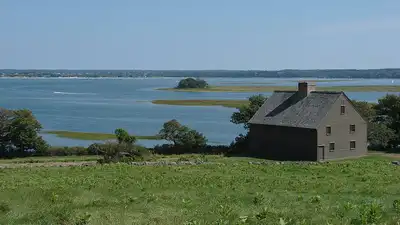
In 1917, the Crane family bought the first piece of Choate Island. Image Credits: Wikimedia Commons.
Choate Island is the largest island in the Crane Wildlife Refuge, covering 135 acres within the refuge’s 697-acre network of coastal islands and marshes in the Essex River Estuary, according to The Trustees of Reservations . More than 200 bird species have been recorded across the refuge, while Choate Island provides habitat for mammals including deer, fisher, coyotes and otters. One of the most visible changes was tree planting, with Cornelius Crane establishing about 95 acres of spruce and pine forest on Choate Island in the 1930s. Over the decades, however, severe storms damaged large sections of the ageing plantation, prompting The Trustees to remove about 30 acres of trees and restore the area as shrubland and young forest habitat. Miné Crane donated about 700 acres of land, including Choate Island and surrounding islands and salt marshes, to The Trustees of Reservations in 1974 in memory of her husband, Cornelius Crane, according to Historic Massachusetts . In 2017, for example, The Trustees and conservation partners cleared about 30 acres of ageing Norway spruce plantation after severe storms had damaged large sections of the forest.
Its spruce forest supports birds such as golden-crowned kinglets and sharp-shinned hawks, while its grasslands provide important habitat for bobolinks and Savannah sparrows. Norway spruce became one of the dominant species, creating a prominent new feature in the island’s landscape. Crane and his wife, Miné, also developed a strong personal connection with the island, using the White Cottage, designed by architect Royal Barry Wills, as a private retreat overlooking Ipswich Bay and the surrounding marshes. The couple were later buried near the island’s summit, where their graves overlook the landscape that had become an important part of their lives. The gift formed the foundation of the Crane Wildlife Refuge, which was later expanded through additional acquisitions and donations. The transition from private estate to protected refuge did not mean freezing the landscape in its historic state. Instead, conservation work has continued to respond to changing ecological conditions. The project created space for shrubland and young forest habitat, supporting species including American black ducks, American woodcocks, eastern towhees and native pollinators. This approach reflects a broader conservation goal: maintaining a functioning coastal ecosystem rather than preserving every element of the landscape exactly as the Cranes left it. The route passes through a changing landscape of grassland, woodland, shoreline and salt marsh, showing how natural habitats and historic features coexist on the island.
Today, visitors can follow gravel roads and mown trails past the historic Choate House towards the Crane burial site near the island’s highest point.
Pingback: In 1922, a Hawaiian family bought a remote Pacific atoll to harvest: The wider industry