
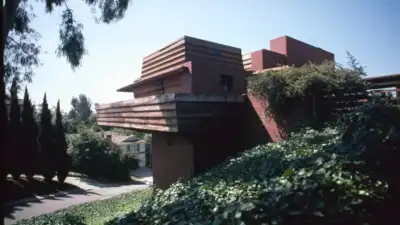
In 1939, Frank Lloyd Wright completed a small house on a steep Los Angeles hillside that seemed to float above the canyon below. The 1,200-square-foot Sturges House, in Brentwood Heights, was commissioned by engineer George Sturges and his wife, Selma, after they encountered Wright’s work in the January 1938 issue of Architectural Forum. Eighty-seven years later, the Sturges House is facing a very different kind of challenge: preservationists say years of deferred maintenance have left the landmark vulnerable to serious deterioration. The Los Angeles Conservancy, the Frank Lloyd Wright Building Conservancy and the nonprofit foundation that owns the property have all offered differing accounts of its condition and stewardship.
The couple bought their steep hillside lot for just $10 in September 1938. Its most dramatic feature is a 21-foot cantilevered deck extending over the hillside. In a February 1939 letter to Lautner, he described the design as “one of the simplest things we have done and one of the best. The Los Angeles Conservancy placed the Sturges House at the top of its 2026 L.A. On July 1, 2026, the Los Angeles Department of Building and Safety issued the property owner a Notice of Code Violation, giving the owner 30 days either to bring the property into compliance or submit a plan for correcting the problems.
Because steel beams had to be introduced into the structure, the house was completed the following year at a final cost of about $11,000, more than the original estimate, in part.
Portions of the original redwood are decaying, the long carport span is warped, and its supporting pillars are rotting, according to the Conservancy. They were particularly interested in his emerging Usonian approach, which sought to bring thoughtful, modern architecture to middle-class Americans at a lower cost. Wright designed the home and asked his apprentice John Lautner to oversee its construction. Built from redwood, brick, concrete and steel, the house has two bedrooms, one bathroom and a compact living-dining area. Its long horizontal lines, local materials and efficient footprint reflect Wright’s Usonian ideals, developed during the economic pressures of the Great Depression. Wright himself appeared pleased with the result. Watch List, saying recent visits found the property in precarious condition. Gaps in the exterior siding may also be allowing further deterioration around the cantilevered structure. The concerns have now reached city officials. The situation is complicated by conflicting accounts of the home’s stewardship.
Today, preservationists are concerned that simplicity is no longer the home’s greatest vulnerability, neglect is.
The All Right Now Foundation, which acquired the property in 2016 with the stated goal of preserving it, says it has invested millions of dollars in purchasing the house, repairs, maintenance, taxes, research and preservation planning. The Sturges House was designated a Los Angeles Historic-Cultural Monument in 1993. For now, the question is whether the 87-year-old structure can be stabilized before its most distinctive feature, the seemingly impossible cantilever that helped make it an architectural landmark, becomes its greatest structural liability.
Its website disputes claims that the property has simply been abandoned and says questions about its condition have created “misconceptions” about its stewardship. The Los Angeles Conservancy says it and the Frank Lloyd Wright Building Conservancy have repeatedly sought a preservation plan and maintenance timeline from the foundation, with those efforts rebuffed. The phrase “demolition by neglect” carries particular weight in Los Angeles.
The preservation groups, however, say the house remains in urgent need of intervention. It describes a situation in which a historic building deteriorates through prolonged lack of maintenance until its condition becomes so severe that demolition may eventually be considered on safety grounds. The Conservancy argues that Los Angeles lacks strong enough mechanisms to force owners to maintain historic properties before deterioration reaches that point. Its preservation would protect more than an unusual house: it would preserve one of Wright’s early experiments in making architect-designed homes smaller, more efficient and more accessible. You use AI every day. Now get your AI Quotient. Take the AIQ test.