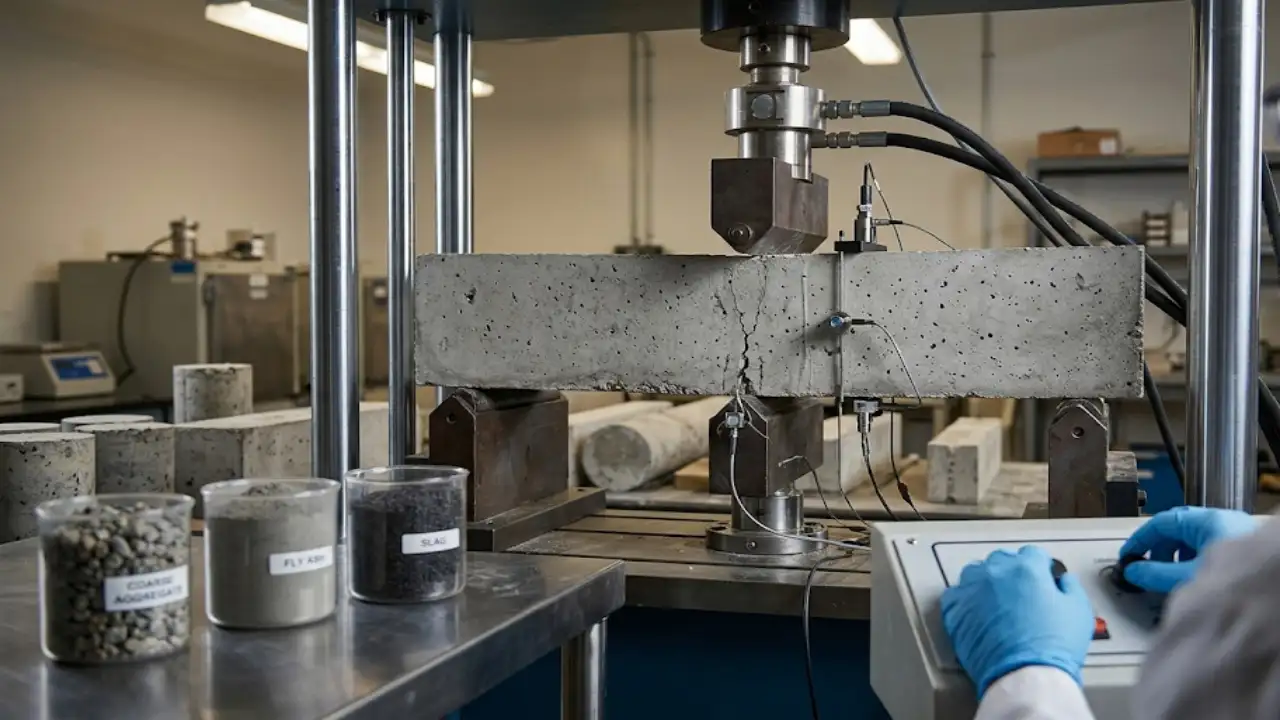
AI-generated representative image showing the reconstruction of Houston’s George Bush Intercontinental Airport runway with a high-performance concrete pavement designed for heavy aircraft. Credits – Gemini
Runway 15R-33L opened to air traffic on June 13, 2002. The runway was 10,000 feet long and 150 feet wide, designed to take Boeing 747s, Antonov 124s and other big aircraft. Its most remarkable feature, however, was hidden in the concrete: half of the cementitious material was composed of 25% Class F fly ash and 25% blast-furnace slag. For the runway upgrade, engineers milled about 8 inches of asphalt in the keel section before placing a 19-inch concrete overlay, allowing the existing pavement structure to remain part of the rebuilt runway. The finished concrete road was about 18 inches thick and covered some 300,000 square yards. The pavement was developed by the engineers of Houston for a flexural strength of 650 pounds per square inch. Trial batches were above the design target, reaching 800 psi in flexure at 90 days. Houston’s Runway 15R-33L demonstrated at full scale that a heavy-duty airport pavement could use a cementitious blend containing 50% industrial by-products. Trial concrete achieved 800 psi flexural strength at 90 days vs. a design basis of 650 psi.
A pavement mixture can therefore be evaluated not only by the compressive force it can withstand but also by its resistance to bending and cracking under repeated aircraft loads. Cementitious blends with high proportions of fly ash and slag produce strength differently than plain portland-cement mixes; therefore, curing, building and opening needs need to be considered in design. Runway concrete must do more than hold up aircraft. It must hold up to repeated heavy loads, resist moisture and be structurally sound for years, which makes the choice of cementitious materials very critical. Engineers at Houston’s George Bush Intercontinental Airport sought to meet those criteria while substituting half of the traditional cement with industrial by-products. Whitetopping involves placing a new concrete pavement over an existing pavement structure rather than removing the entire roadway. It had to be designed to withstand bending forces generated by very large aeroplanes moving across the slab time and again. Flexural strength is of special concern for pavements, since concrete slabs flex under the passage of aeroplane loads. Not every batch of concrete acted the same in Houston. Engineers later explored trouble at a critical runway intersection at neighbouring William P. Hobby Airport, which used a high-early-strength concrete mixture. ASCE performed a different study on the Hobby Airport runway restoration, indicating the service life of the previous pavement was decreased and the deterioration was mostly caused by the production of secondary ettringite crystals. Given the great emphasis on minimising runway closure time, fast strength development was a crucial feature of the original design. There were tradeoffs. A runway closure to allow concrete to gain strength presents a different problem than an emergency repair that must be opened within hours. Initial field cores indicated satisfactory compressive strength and minimal permeability. It was not just a case of replacing Portland cement with waste materials. Engineers had to find a blend that was right for the aircraft loads, the construction process and the long-term durability needs.