
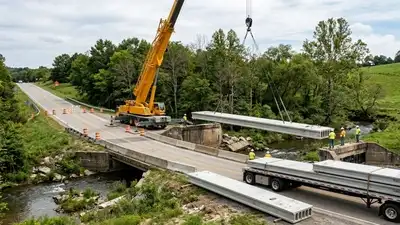
AI-generated representative image showing precast concrete bridge slabs being lifted into place during a rapid highway bridge replacement. Credits – Gemini
In the summer of 2008, the Maryland State Highway Administration tried a different approach on two deteriorating bridges. The two bridges were across Washington Run near Point of Rocks and Bacon Ridge Branch near Annapolis, carrying MD 28 and MD 450, respectively. It put construction time at three months, with only two months of road closure, against the 15 months projected for a typical job of this sort. For MD 28 alone, it estimated savings of about $1.49 million, roughly 32% of the project cost. The old bridges and their replacements Both of the existing bridges were about 80 years old and classified as structurally poor and operationally outdated. The MD 28 structure was a 37-foot-long, two-span slab bridge was 36 feet long and handled roughly 8,000 vehicles per day. MD 28 used 10 slabs measuring four feet by 41 feet, and MD 450 used 10 measuring four feet by 56 feet, plus one smaller slab. A full shutdown with diversion would be around two months and on the order of $15,000 per site for traffic control. A one-lane with signals would take roughly 15 months and cost $100,000. A temporary bridge would take 24 months and cost $185,000. The closure began on about 17 June 2008, about two weeks after the end of the school year. The contractor had 60 calendar days to earn the full incentive and 75 before penalties kicked in. MD 450 took around three months and MD 28 about four, as drilling for foundations went twice as deep as soil investigations had projected. The slab superstructure itself was finished in 15 days, compared to 20 days by standard methods. The MD 28 diversion added nearly eight miles and about 10 to 11 minutes to a trip. Credits – Gemini How the $1.49 million adds up The number $1.49 million is an estimate and relates just to MD 28. The research attributes around $326,000 to cheaper construction, $289,500 to lower work zone costs and $1.35 million to avoided safety expenditures, since staff inside a closed road have no passing traffic. Subtract the extra $475,650 in delay and fuel expense from detouring drivers. Add it all together, and you get a little over $1.49 million against a baseline of $4.63 million.
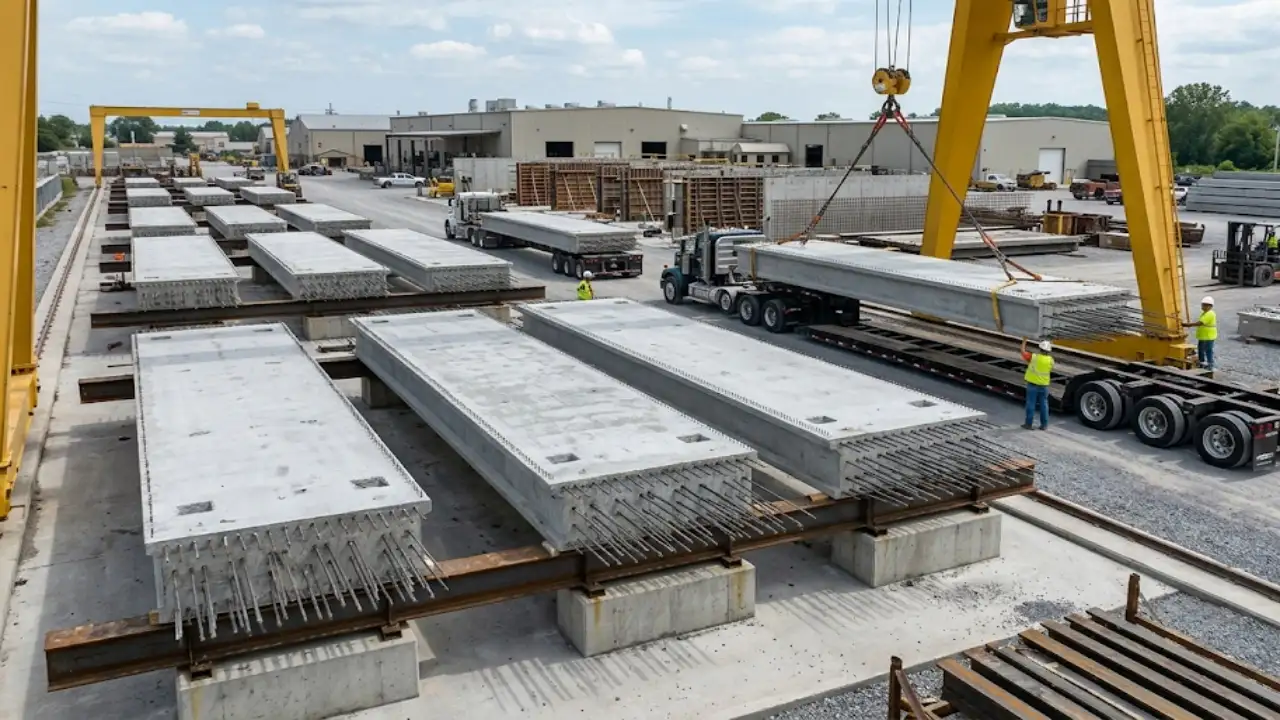
But fast work only counts if the numbers equal up; therefore, the cost side demands a more profound study. On a typical rural bridge replacement, school bus routes are disrupted, traffic creeps through a single lane managed by temporary lights, and the work drags on for more than a year. It had the new spans built in a factory, shut down both highways entirely, and gave the contractor a bonus for finishing ahead of schedule. Both were replaced by precast concrete slabs, produced elsewhere and hauled into place by crane. Casting decking on site would have added at least three weeks to each bridge, whereas the slabs can be set in a single day, a Maryland official claimed in an FHWA newsletter at the time. The Federal Highway Administration’s Highways for LIFE final report later estimated the outcome. The study explains why the savings were so substantial. They were replaced with prestressed concrete slabs cast at a precast plant. Workers placed steel tie rods across the slabs, grouted the joints between them and poured a concrete overlay on top to form the road surface. Each slab end rests on abutments that were cast on site. Any slab needing field drilling or coring would be refused, leaving only grouting and overlay for the site. The rule was small, but it protected a schedule with no spare weeks. But the slabs were only part of the picture; the bigger advantage lay in how the roads were shut. Closing the roads outright The road is closed for the foreseeable future. The standard process in Maryland for a bridge of this scale is to leave one lane open with temporary signals. The Highways for LIFE final report explained that traffic studies compared three alternatives. The two bridges were awarded under one contract, the first time Maryland had awarded two major bridges to a single contractor. Reality was messier than the plan. Drivers also incurred costs. AI-generated representative image showing factory-made precast concrete bridge slabs being prepared for transport to a highway replacement project. The total is compared with a standard one-lane job.
In Maryland, the contractor had to build every slab of every bridge at the plant before shipping, so any off-centre tie rod hole would be discovered long before the crane arrived.
The low bid for the two bridges was $3.5 million, roughly 5% below the engineer’s estimate of $3.7 million, according to Florida International University’s bridge database . Because the contract was still open, the report said final construction costs were not available. Because a local fire company raised concerns about reaction times to the bridge, a full shutdown can happen only if there is a reasonable detour, and the MD 450 site was selected in part. Because the foundation surprise cost a month and Maryland has since utilised nighttime single-lane closures to explore soil before blocking roads on comparable operations, field studies are also important.
The contractor said there was little room to improve the schedule further. Much of that saving is modelled rather than realized. The safety figure assumes… You use AI every day. Now get your AI Quotient. Take the AIQ test.