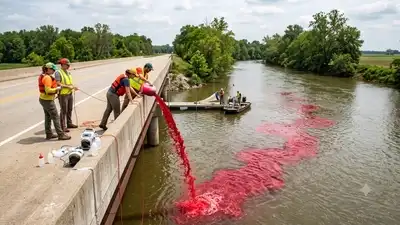
An AI-generated image showing researchers releasing red tracer dye into Ohio’s Sandusky River to measure how material drifting in the current moves downstream during grass carp spawning research. Credits – Google Gemini
On 11 July 2017, USGS researchers injected 13.5 litres of Rhodamine WT dye into the Sandusky River at the Tiffin Road bridge crossing. Spawning was first confirmed in the Sandusky River in 2015, when researchers collected fertilised eggs drifting downstream, and further surveys in the years that followed documented repeated spawning events in the same stretch of river. Credits – ChatGPT Turning drift times into a map of where carp spawn Ichthyoplankton nets at multiple sites along the lower Sandusky River had already collected thousands of grass carp eggs on several dates in 2017. In June 2018, researchers collected fertilised eggs and adult grass carp within that model-predicted spawning area, confirming the location and validating the modelling approach.
Because they leave visible damage behind, such as stripped vegetation or a collapsed food web that points investigators to the culprit, some invasive species are easy to track. Because they spawn by releasing eggs directly into moving water rather than building a nest researchers can easily locate and observe, grass carp are harder to track. Because fertilised grass carp eggs behave in a specific way once they are released, that confirmation mattered. Because the dye moved with the river current, the data showed how quickly material entering the river near a suspected spawning site would reach each downstream sampling point and how that timing varied with flow.
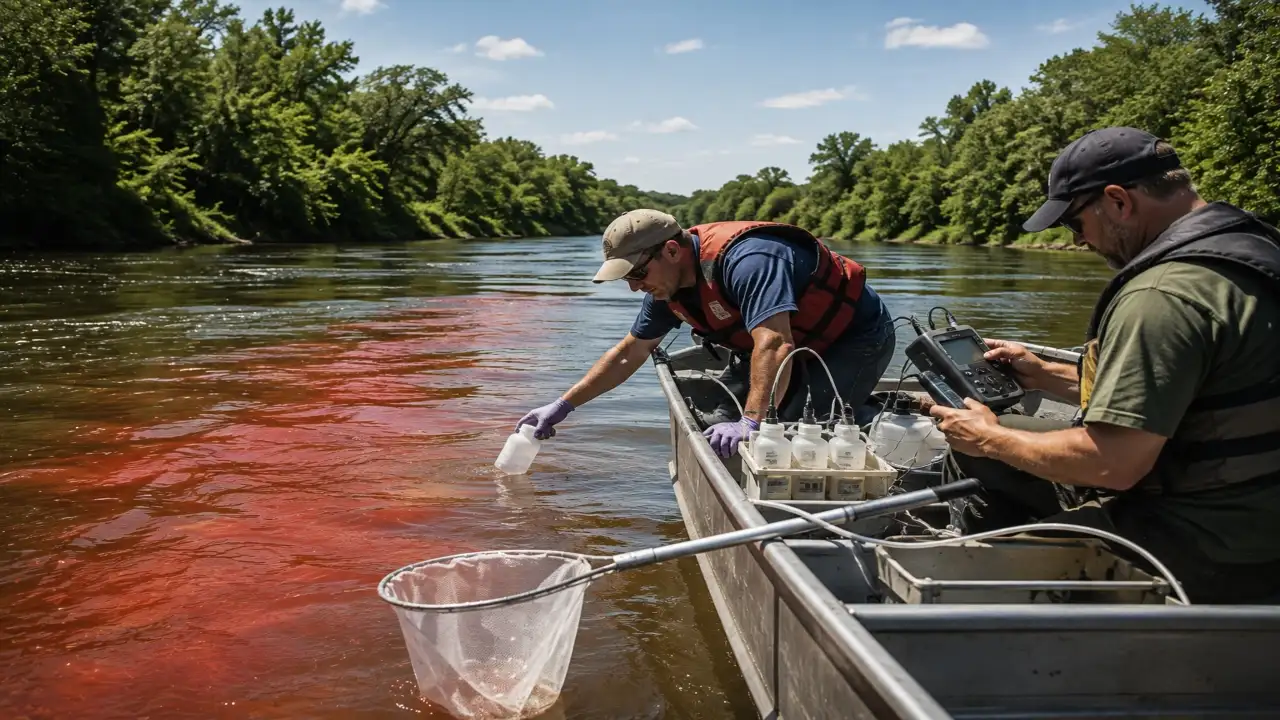
An AI-generated image showing scientists monitoring the Sandusky River downstream after a red dye tracer was released to study water movement and help model the drift of grass carp eggs.
The dye was injected near the Tiffin Road bridge crossing, and its concentration was then recorded at fixed monitoring stations downstream over the following two days, alongside water velocity and discharge readings taken from survey boats stationed on the river, according to a USGS data release. Scientists working on Ohio’s Sandusky River needed a way around that problem. The timing was deliberate. A grass carp spawning event was already underway downstream, and scientists from the US Geological Survey wanted to know how far and how fast a fish egg would drift once it entered the water. Those measurements could then be used to improve models of where grass carp eggs were likely to have originated. Why a river needed to be dyed at all Grass carp are not native to the Sandusky River or anywhere in the Great Lakes basin. The species was brought to the United States in the 1960s to control aquatic vegetation, and escaped populations later established themselves in the Mississippi River system before spreading toward Lake Erie. Rather than sinking or sticking to the riverbed, they remain suspended in the current as they drift and develop, so their fate depends largely on how the water is moving. That single fact, that eggs travel much like any other object caught in the current, is what made a dye tracer study worth running in the first place. Watching red water pass a string of stations Rhodamine WT, the dye used in the study, is a bright red compound that fluoresces under the right light and can be measured at very low concentrations, making it useful for tracing how quickly water moves through a river system. Matching the dye data against the eggs researchers found in their nets was the next step, and it is where the study’s value emerged. Pairing that catch data with the dye study allowed scientists to work backward from where an egg was caught to roughly where and when it was spawned. A related USGS publication describes using drift modelling to estimate a likely spawning location several kilometres downstream of Ballville Dam. The dye tracer study filled that gap by using coloured water and careful timing. The approach has since become a template for tracking other river-spawning species whose eggs, like grass carp eggs, drift rather than stay put. Catch the latest World News and Live updates. Download the TOI app.