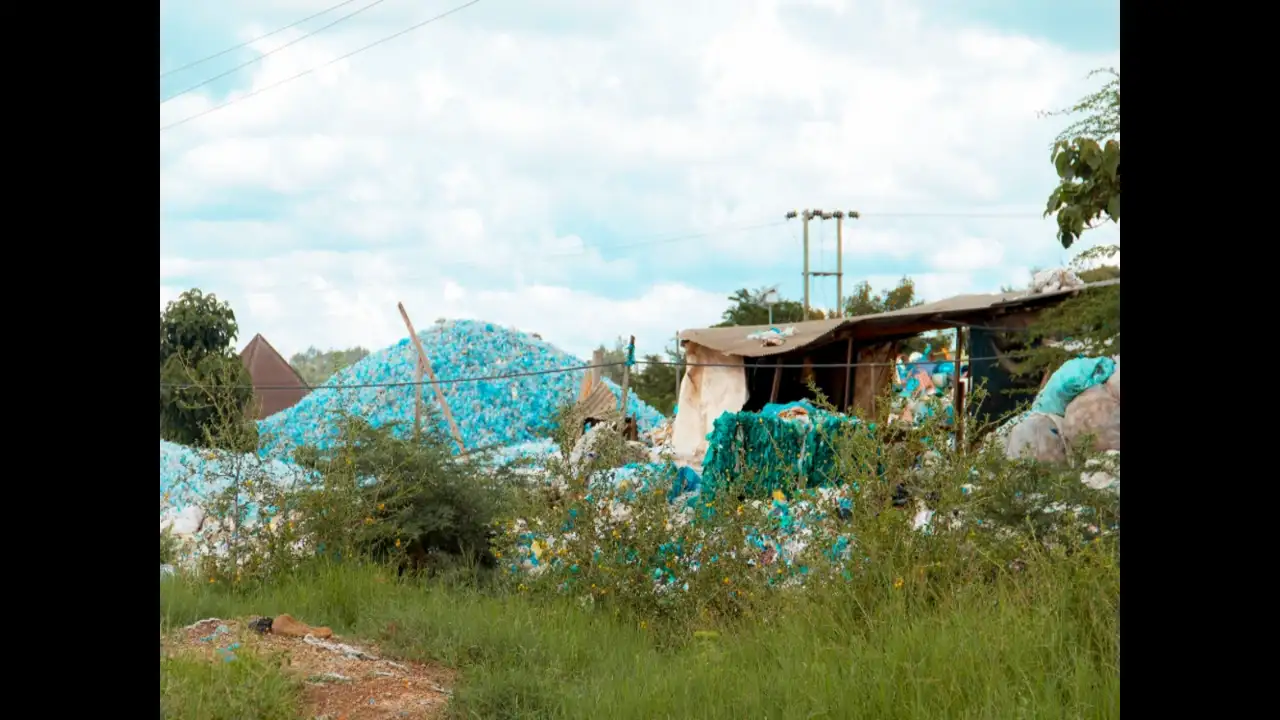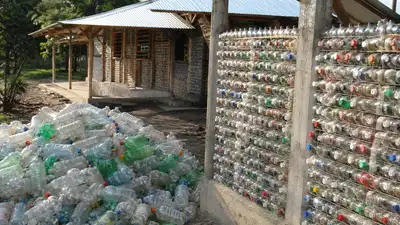
Representation of a school built with thousands of discarded plastic bottles, showcasing an innovative approach to turning waste into useful building materials. Image Credits: ChatGPT.
When American Peace Corps volunteer Laura Kutner arrived in the mountainous community in 2007, she encountered both a shortage of classroom space and a persistent waste problem. Because a plastic bottle does not automatically become a replacement for a concrete block simply because it is tightly packed with rubbish, this is important. A discarded plastic bottle is usually treated as a piece of waste, but in Granados, Guatemala, thousands of them became part of a school. Two unfinished classrooms already had metal frames and roofs, but there was not enough money to complete the walls. Kutner eventually found a way to turn the rubbish around the community into a construction material. The Granados project was more than an unusual recycling exercise. It demonstrated how a material with little immediate value could be incorporated into a low-cost construction system when conventional building materials were difficult to afford. Research published in Materials & Design later examined the physical properties of PET bottle eco-bricks made by packing waste plastic into bottles. Laboratory tests found that their mechanical strength was closely related to how heavily the bottles were packed, while the researchers also identified potential benefits in sound insulation and light transmission. The study concluded that such eco-bricks could have construction applications, although their suitability depends on how they are manufactured and where they are used. The project showed something more practical: even a material regarded as worthless can become useful when a community has the need, organisation and technical guidance to put it to another purpose. In Granados, thousands of bottles that might otherwise have remained scattered around the town instead became part of a school where children could learn. And the method did not remain confined to those two classrooms. It became an example that other communities in Guatemala chose to adapt, turning a small local experiment into a much wider idea.