
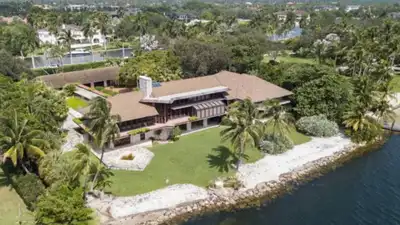
A multimillionaire property developer from Texas has demolished a historic waterfront mansion in Coral Gables, Florida, only months after buying the estate for $36 million. Felix Sorkin, founder of the Houston-based manufacturing company General Technologies, bought the 11,000-square-foot property in mid-2023. Known as the Wood Residence, the estate was designed in 1963 by Alfred Browning Parker, one of South Florida’s best-known modernist architects.
Despite efforts by local heritage advocates to save the landmark, bulldozers tore down the residence to make way for a large modern mansion, the Miami Herald reported. The demolition has sparked anger among local preservationists and architectural historians. The loss of the home shows the growing conflict in South Florida between rising land prices and efforts to protect mid-century architectural history.
Built on a prime 1.2-acre lot along Biscayne Bay, the Wood Residence was widely seen as a fine example of organic architecture. Sorkin’s $36 million purchase set a significant price benchmark for the neighborhood. Because of this, Sorkin was legally allowed to apply for a standard demolition permit after completing the purchase.
Parker designed the house to make the most of natural ventilation and light, according to research cited by the Miami Herald. Preservationists said the home was one of the finest surviving examples of Parker’s residential work. Parker, a protégé of Frank Lloyd Wright, designed the home with natural materials, including heart-pine woodwork, native stone walls and large glass panels. These features helped connect the indoor spaces with the surrounding tropical landscape. These features were central to his modernist style, which was designed for the local climate. The house also had a striking sloped roof, custom mahogany cabinets and an open floor plan that influenced mid-century home design across the region. However, the property did not have formal local historic designation. The demolition reflects a wider economic trend in South Florida’s luxury real estate market. In areas such as Coral Gables, Miami Beach and Key Biscayne, the land itself can be worth more than the historic buildings on it. Property records sourced by the Miami Herald show that wealthy buyers are increasingly buying older estates mainly for the size and location of the land. Buyers often choose to demolish existing buildings and construct larger, ultra-modern compounds. These new homes can offer higher ceilings, stronger hurricane protection and larger amenities that older designs may not easily support. Construction plans filed with the city show that the Texas industrialist plans to build a new custom luxury residence on the cleared Biscayne Bay property.
Alfred Browning Parker, who died in 2011, created more than 6,000 residential and commercial designs during a career that lasted six decades. His work received national attention and appeared in major architecture publications during the 1950s and 1960s. This included House Beautiful, which devoted entire issues to his climate-conscious home designs. Architectural historians consider Parker an important figure in adapting modernism to subtropical areas. He used local materials, deep roof edges for shade and direct connections to natural waterways. With the Wood Residence now gone, preservation groups are urging municipal leaders in Miami-Dade County to update historical surveys and identify vulnerable mid-century buildings before similar sales take place. City officials have acknowledged the community’s concerns, but no immediate changes to the Coral Gables historic preservation ordinance have been enacted.
These choices helped set an example for sustainable coastal design long before the idea became widely used in architecture.