
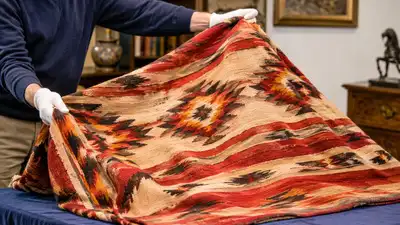
Representative AI image of an antique blanket being examined by an expert after its unexpected discovery as a valuable piece. Image Credits: ChatGPT.
John Moran Auctioneers said the blanket was a rare Navajo First Phase chief’s blanket from the mid-19th-century period, which it sold at auction for some $1.8 million, including fees. An old blanket kept in a family closet for years turned out to be a valuable piece of Native American textile history. A man in California had inherited the piece and initially thought it was just a family heirloom until it was looked at more closely.
The textile then stayed in the family for 142 years, handed down from generation to generation until it appeared in a museum. That was until 2011, when he saw an episode of the TV program Antiques Roadshow in which an elderly man presented a comparable Navajo blanket, which was valued at $ 500,000. He ultimately submitted the item for auction at John Moran Auctioneers in California in March 2012. The auction house determined that it was an exceptionally rare First Phase Navajo chief’s blanket from around 1840, with the piece’s history with the Chatland family and its pristine condition both contributing to its value. Why the 1840 Navajo blanket was so valuable The gold blanket was valued for its age, the weaving, the material, and the rarity. The approximate dimensions are 171.5 by 141 cm. The first phase blanket, which was introduced around 1800, had a reputation for its close weave and symmetrical use of colour, and was worn as a shoulder garment and traded widely to people on the Great Plains.
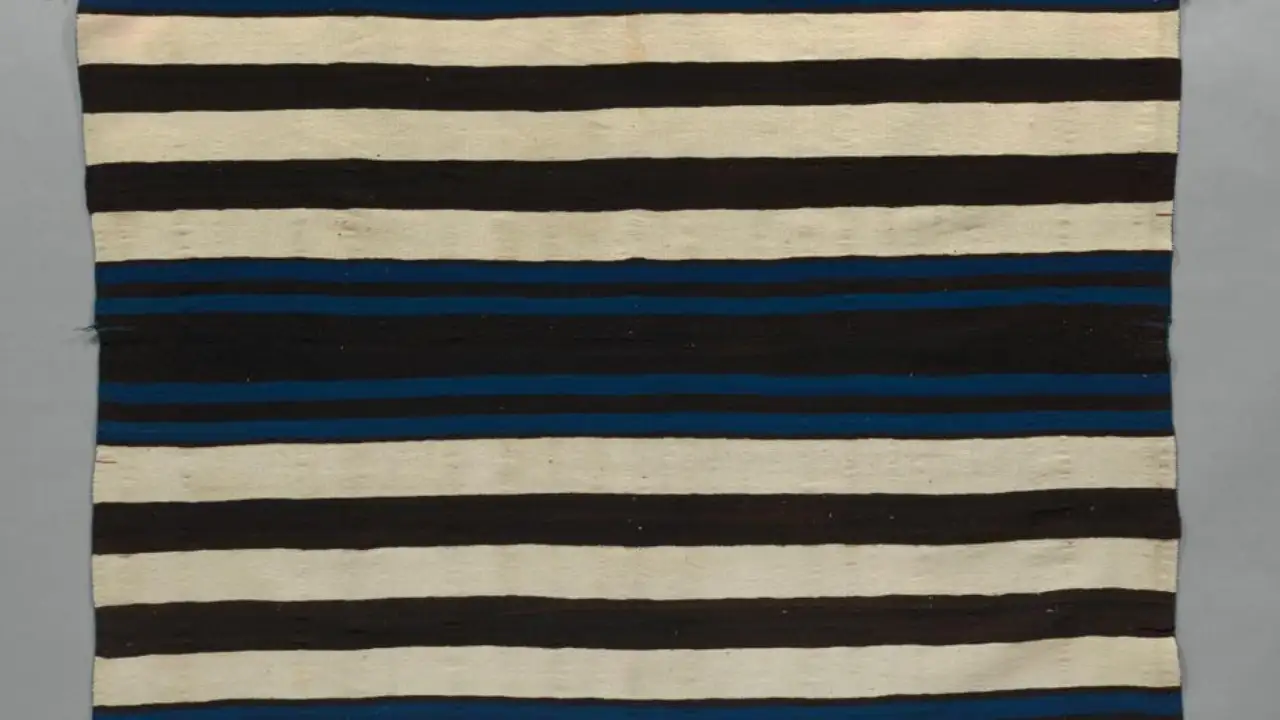
The revelation showed how potentially precious artefacts can sit in an individual’s house for years and end up as a badly faded domestic blanket. The blanket was an actual example of early Navajo weaving, an art form with a long tradition known for its skill, design and historical value. Its sale also showed the elite interest in the history of Navajo textiles and collectors’ fascination with indigenous work. A family heirloom that remained unnoticed for generations The blanket originated with Loren Krytzer, who lived in California and her ancestor, a Norwegian immigrant, John Chantland. It can be traced back to the 1870s, when Chantland, who owned a general store in Mayville, Dakota Territory, traded for it. Krytzer kept the blanket in a cupboard for years, oblivious to its historical value, and he had little reason to think that the one old piece of textile would fetch much. He recognised the similarity and started to re-evaluate the family’s piece. It was hand-spun and woven in natural ivory, dark brown and black, and indigo-dyed blue and lac-dyed red fibres. The weaving shows a concentration on horizontal stripes rather than the complex geometrical patterns that were produced in later phases of Navajo weaving. The title chief’s blanket is a modern invention, but its status and connection with wealthy wearers suggest the name is applicable. Research published in KIVA looks at the transmission of weaving skills and design among the Navajo kingship groups, which provides some explanation as to why these older weavings are appreciated and collected as a cultural object, not just as find textiles. North American Indian Navajo blanket, handspun, undyed and indigo-dyed Churro fleece and raveled lac-dyed bayeta. Image Credits: Wikimedia Commons. A record-breaking auction and an unexpected fortune
John Moran Auctioneers initially valued the blanket at between $100,000 and $200,000, but collectors and dealers quickly drove the price far higher. Scientific testing on the dye showed that the red contained lac dyes and the blue contained indigo, with no indication of any synthetic dyes, confirming that the blanket was genuine and from 1800. The item was auctioned on 19 June 2012 at a Pasadena Convention Centre in California, and following heated bidding from online and on-site bidders, the winning bid was placed by the dealer based in New York, Donald Ellis, for $ 1.5 million. The item eventually sold for $ 1.8 million. The estimate was far exceeded, setting a new auction record for Navajo textiles and surpassing the previous high of $522,500 set in 1989 for a First Phase chief’s blanket.
The sale is a reminder of how historic art can preserve outstanding culture and monetary value, even while the value of the blanket is more than just scale. Thus, the value of the Chantland blanket is more than just a tag at auction. It is a skill of Navajo weavers, a symbol of indigenous textile trading, and the preservation of traditional craftsmanship across generations. You use AI every day. Now get your AI Quotient. Take the AIQ test.