
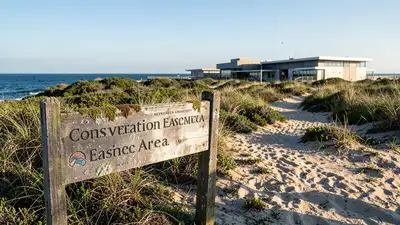
Representative Image of a coastal peninsula with conservation easements protecting land around Northeastern University’s Marine Science Center (AI-generated image)
Northeastern owns 20.4 acres of the peninsula, including the site of its Marine Science Center, while the town owns the remaining 8.3 acres, which it maintains as a public park. In 2018, Northeastern announced plans to expand its campus at East Point. The proposal included a 55,000-square-foot building, additional parking and a geothermal wellfield. In May 2021, town meeting voted to authorise the use of eminent domain to acquire conservation and public access easements over university land. The votes approved the taking and the use of $1.5 million in Community Preservation Act funds to help pay for it. The town’s board of selectmen subsequently issued an order covering two conservation easements and one access easement across roughly 12 acres. The Nahant Preservation Trust, a nonprofit organisation, donated $3 million earmarked for the taking under a gift agreement. The Superior Court agreed with the university, dismissed the town’s petition and awarded Northeastern more than $1 million in attorney’s fees and costs. Burlington, a 1987 Massachusetts decision, the court established that a municipality cannot use eminent domain solely to prevent a development while disguising that objective behind a purported public purpose.
Northeastern pointed to statements by officials and residents opposing its expansion, suggestions that the taking could be used as leverage, and the fact that the town began pursuing eminent domain after the university announced its plans. Access to the park crosses university property under an existing easement. The plans prompted opposition from residents and town officials concerned about development in the area. The conservation easements would preserve the land in an open condition and prevent new buildings, while allowing existing structures to be used and maintained. The access easement would establish public rights to use Canoe Beach for outdoor recreation. Nahant petitioned the Massachusetts Superior Court to establish its right to acquire the easements. Northeastern challenged the action, arguing that conservation was not the town’s true objective and that the taking was intended to stop its planned expansion. The town appealed. The university also argued that the Dover Amendment, which limits the extent to which local zoning rules can restrict certain educational uses of land, should prevent Nahant from using eminent domain to interfere with its planned campus development. The court disagreed. It noted that the Massachusetts Legislature had imposed specific restrictions on eminent domain involving certain categories of land but had not created a comparable restriction for property used for educational purposes. The ruling does not mean the town can acquire the easements without paying the university. The court stressed that Nahant must provide Northeastern with just compensation for the property rights taken. The central dispute concerned whether the town was using conservation as a pretext to block Northeastern’s development. In Pheasant Ridge Associates Limited Partnership v. It argued that these circumstances showed the conservation rationale was not genuine.