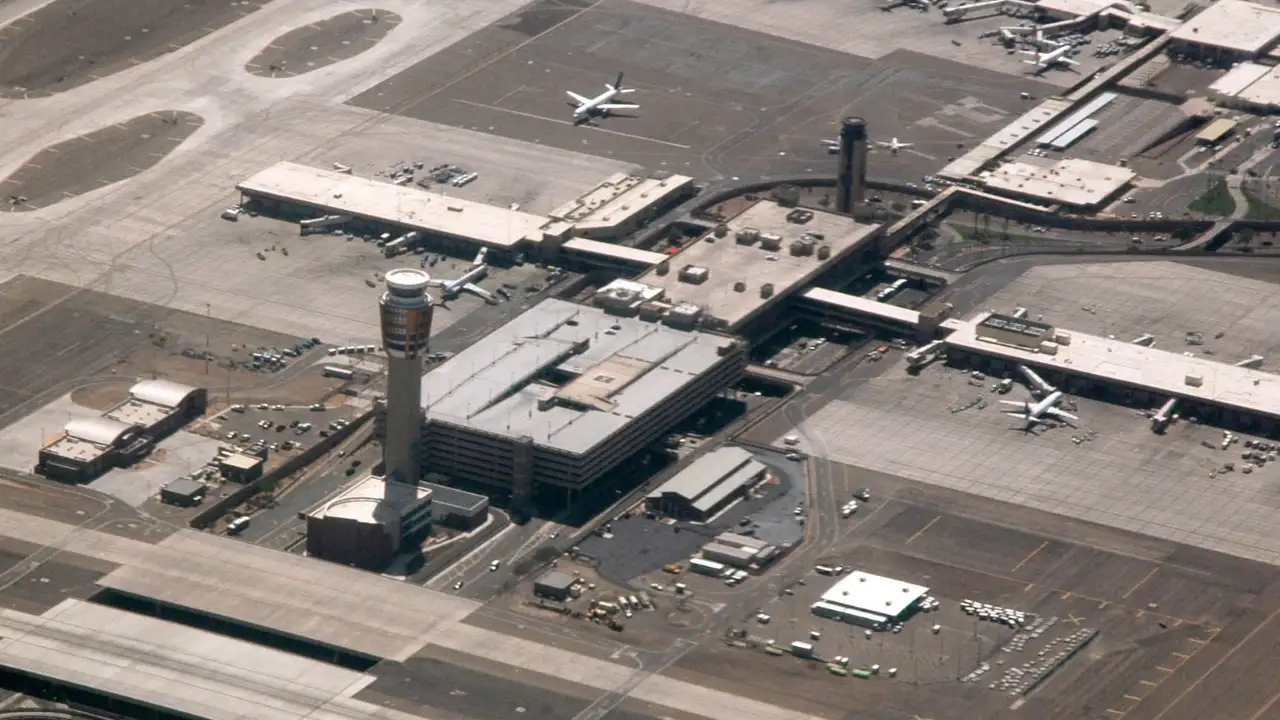
Sky Harbor International Airport | Wikimedia Commons
Phoenix treated the main runway at Sky Harbor International Airport with an asphalt-rubber seal in June 1972 and left the taxiway adjacent to it untreated. The asphalt beneath the untreated taxiway had hardened more than 20 times as much as the asphalt protected by the rubber seal, which was the result of thirteen years of pavement sampling. Russell Howard Schnormeier, who was an engineer with the City of Phoenix, documented the comparison in a 1986 paper that was published in Transportation Research Record , with the two surfaces using otherwise identical asphaltic concrete. Researchers collected pavement cores from the runway and taxiway at intervals between 1972 and 1985, and then measured the viscosity of the asphalt cement that had been recovered. The 1985 measurements showed a substantial difference between the two surfaces, with one comparison showing that asphalt from the treated runway had a viscosity of 1,125 poises at 140°F, while the untreated taxiway’s asphalt measured 92,500 poises; another comparison recorded more than 200,000 poises in the untreated section, compared with 1,411 poises in the treated section. The paper also reported that crack reflection was prevented and surface maintenance had been eliminated for 13 years, although the runway required periodic high-pressure water cleaning to remove rubber buildup from aircraft tires. A 1991 study by Equbalali Charania, Joe A. The airport comparison is still a very specific example of the treatment’s reported effect on asphalt aging, and after 13 years, the treated runway’s asphalt retained far more of its original viscosity than the untreated taxiway’s asphalt.
The main runway received a stress-absorbing membrane, or SAM, that was made from asphalt-rubber and small stone chips, while the adjacent taxiway did not receive the treatment. Viscosity is a measure of a material’s resistance to flow, and changes in asphalt viscosity can help indicate how much the binder has hardened with age. The difference was attributed to the seal’s ability to limit the loss and reaction of volatile components in the asphalt, with the untreated material becoming brittle and cracked, while the treated surface was able to retain more of its flexibility. The test measured the properties of asphalt recovered from pavement cores, and not just the visible condition of the runway, with the viscosity measurements providing a numerical comparison of how the binder aged under the two treatments. Cano, and Schnormeier reviewed the city’s wider experience with the material, which included its use on streets and at Sky Harbor, and described the treatment’s ability to retard cracking and preserve asphalt properties, while noting that the performance varied with pavement conditions and construction details.