
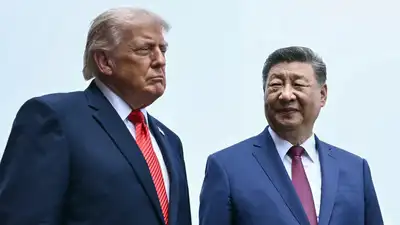
File photo: China’s President Xi Jinping, right, and US President Donald Trump
A proposed $14 billion US arms sale to Taiwan is emerging as one of the most sensitive issues hanging over US President Donald Trump’s meeting with Chinese President Xi Jinping this week, with Beijing pressing Washington to keep the deal on hold while Taipei tries to make the case that its security is in US interests.
The current uncertainty marks a shift from Trump’s first term, when his administration approved about $18 billion in arms sales to Taiwan. He said securing a continued delay in US arms sales could therefore be one of Beijing’s most important objectives.
Xi is expected to push Trump to continue delaying the package, which includes missiles, anti-drone weapons and air-defence systems, according to a report by the New York Times. Trump has already held off approving the sale and previously described the deal as a potential “negotiating chip” with China. Xin Qiang, director of the Center for Taiwan Studies at Fudan University, told NYT that Taiwan was the issue most capable of causing relations between Washington and Beijing to deteriorate sharply. Chen Ming-chi, a deputy Taiwanese foreign minister handling relations with the US, told The New York Times that American officials understood the importance of continued arms sales to Taiwan.
For Taiwan President Lai Ching-te, the continued delay is creating a political problem. Lai has pushed for higher defence spending and greater purchases of US weapons, partly in response to pressure from the Trump administration for allies and partners to contribute more to their own defence. At the same time, the broader US-Taiwan security relationship remains active. Taiwan’s defence minister Wellington Koo recently indicated that American military advisers had become more visible during the island’s annual Han Kuang exercises.