
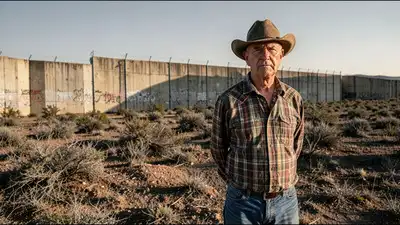
Representative Image of a Texas rancher standing before a border wall, conflicted by its impact on land and the environment (AI-generated image)
In August 2026, agents arrested 8,870 people along the entire southern border, including 161 in the Big Bend sector. Customs and Border Protection has said it is building an average of about 12 miles of barrier per week and recently passed 200 miles of new barriers built during President Donald Trump’s second term, according to AP.
The administration says the infrastructure is part of its wider effort to maintain low levels of illegal border crossings. Parts of the Rio Grande run below steep limestone cliffs, while remote stretches are accessible only by rocky trails and through difficult desert terrain. Supporters of the project argue that walls, vehicle barriers, patrol roads and surveillance technology are needed to deter crossings and smuggling. The administration has also warned that leaving gaps in border infrastructure could push illegal crossings and smuggling toward less fortified areas. Border Patrol arrest figures cited by AP illustrate the difference in enforcement activity across the region. These figures measure arrests, not the total number of attempted crossings. Opponents argue that the region’s natural barriers and comparatively low number of arrests make an extensive wall unnecessary. Some local law enforcement officials have advocated surveillance towers and drones as alternatives.
The Zuberbueler family, whose Val Verde County ranch dates to 1898, is concerned about the effect of construction on livestock and water supplies. A 2017 ProPublica investigation reported that the Department of Homeland Security filed more than 360 eminent domain lawsuits in less than a year after 2007 across Texas, New Mexico, Arizona and California.
the family says the barriers could prevent cowboys from moving freely across the property Although the animals can pass through vehicle barriers. The family raises Angora goats and Rambouillet sheep on land extending toward the Rio Grande. Some landowners remained involved in court proceedings for years. The immediate future of the Big Bend project depends in part on the ongoing legal proceedings. The temporary order has halted construction while the administration challenges it, but it does not by itself resolve the broader dispute over federal authority, property access or the merits of building a wall across the region. The court proceedings will determine how the legal challenge proceeds as landowners and officials continue to contest the project.
Earlier border wall disputes provide historical context for the use of eminent domain.
Across the southern border, about 70 cases had been referred to the department during Trump’s second term, with 50 resolved and none requiring a trial, the official said. Because much of the land along the border is privately or state-owned, texas presents a particular challenge for federal construction.
Courts have generally deferred to the government in eminent domain cases, and earlier lawsuits seeking to stop border wall projects have largely failed, according to AP reporting on the legal disputes. A Justice Department official who spoke to AP on condition of anonymity said the Customs and Border Protection had reached agreements with dozens of Big Bend landowners. The government must obtain authorisation to enter private property for surveys and construction. When owners refuse access, federal authorities can pursue eminent domain, the process through which the government takes private property for public use in exchange for compensation.
A $46 billion plan to expand the US-Mexico border wall is facing resistance from Texas landowners, while a separate lawsuit has halted construction in the Big Bend region. On October 2, 2026, US District Judge Kathleen Cardone of the Western District of Texas, in El Paso, granted a preliminary injunction in a case brought by the Center for Biological Diversity, Friends of the Ruidosa Church and river guide Danny Miller Jr. Separately, the No Big Bend Wall Coalition, which says its network includes more than 200 landowners, has challenged the administration’s plans. The coalition’s lawsuit is distinct from the case that produced the October 2 injunction. As of October 15, 2026, the Trump administration was seeking to suspend the injunction while pursuing Supreme Court review. In a court filing reported by Marfa Public Radio on October 9, the government asked Judge Cardone to suspend the order and said it intended to seek relief from the Supreme Court. Inside Climate News reported on October 15 that Justice Department attorneys were continuing to pursue that course.
Terrell County Judge Dale Lynn Carruthers said the county had limited control over the federal project and suggested that refusing the lease might simply lead the contractor to find another location. The order blocks specified construction activities while the case proceeds and stays the federal waivers used to expedite the project. The disputes concern federal authority, private property, environmental protections and the need for border barriers in a region with comparatively few Border Patrol arrests. The No Big Bend Wall Coalition has separately challenged the project, arguing that the Department of Homeland Security is misusing its authority in a region with limited illegal cross-border activity. That injunction was granted by US District Judge Kathleen Cardone in a lawsuit brought by the Center for Biological Diversity, Friends of the Ruidosa Church and Big Bend river guide and landowner Danny Miller Jr. The plaintiffs challenged the federal government’s use of waivers to bypass environmental and other laws to accelerate construction. The preliminary injunction covers the Big Bend Border Patrol Sector within one mile of the Rio Grande, as well as Big Bend National Park and Big Bend Ranch State Park. It also stays the relevant federal waivers while the case proceeds. The order remains in effect until the court resolves the case on its merits, unless it is modified or stayed. Resistance extends beyond the courtroom. Landowners and business owners have attended county meetings, protested against proposed agreements with contractors and monitored construction areas for possible violations. Some have urged local authorities not to provide land or road access to companies working on the project. In Terrell County, residents unsuccessfully opposed leasing airport land to a barrier contractor. In Jeff Davis County, a proposed agreement allowing another contractor to use a county road had not been approved at the time of AP’s reporting.