
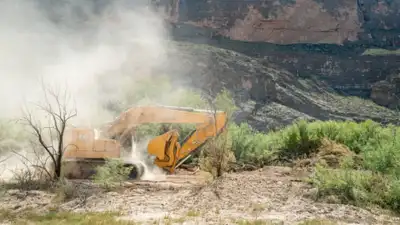
Texas landowners feared border barriers would cut off access to the Rio Grande; an October 2 court order now blocks construction in the Big Bend sector while the legal challenge continues/Image: Getty Images
US District Judge Kathleen Cardone on Friday granted an environmental group’s request for a preliminary injunction, keeping a halt on “ground-disturbing activities” in place while a broader legal challenge to the border projects moves through court. A federal judge has blocked further construction of border barriers in Texas’ Big Bend region after landowners and local groups warned that the planned infrastructure could cut off their access to the Rio Grande and permanently alter the landscape. At the end of Friday’s hearing, Cardone asked those in the courtroom to remain calm as she read her order from the bench. She found that the plaintiffs were likely to succeed on their constitutional claims challenging the construction. The lawsuit was filed in April by the Center for Biological Diversity on behalf of the Friends of the Ruidosa Church, a nonprofit seeking to preserve a historic church in Presidio County, and Danny William Miller, a Rio Grande river guide and landowner whose property in Redford could be affected by the planned wall. The plaintiffs argue that five contracted border wall projects in the region are unconstitutional on several grounds, including that they violate the separation of powers and deprive citizens of their land. For residents living along the Texas-Mexico border, the dispute is not limited to where a barrier would be built. They say the infrastructure could change how they use their land and reach the Rio Grande.
The lawsuit documents what the plaintiffs say could be lost if border barrier construction continues along the Rio Grande.
Texas-based news outlet, Miller, who works as a river guide, told the court that having a wall built across his property and losing access to the river would be like “a bullet to the head”, according to the Big Bend Sentinel. His work as a river guide, he said, would become “a tour of the military industrial complex, rather than a tour of the wilderness. “They’re taking the river away from us, and it’s devastating,” he testified. “The harm reaches far beyond the landscape itself,” Graves said in closing arguments. Officials argue that barriers are necessary to achieve what they describe as “operational control” of the border, meaning zero unauthorised border crossings. “Since the President took office, DHS has delivered the most secure border in history,” Noem wrote.
He also argued that the desert landscape, once altered by construction, could not simply be restored. Bill Guerra-Addington, a Hudspeth County resident, similarly warned that a border barrier would effectively destroy his ranch. Zeynep Graves, an attorney with the Center for Biological Diversity, argued that the consequences of the construction would extend beyond environmental damage. The federal government has defended the need for physical border infrastructure, including in remote areas such as Big Bend. Former Homeland Security Secretary Kristi Noem made the case in a series of waivers that eased contracting requirements across the southwestern border. “More can be done, however. The government has also raised the possibility that changes in migrant routes could increase pressure on the Big Bend region if barriers are expanded elsewhere along the southern border.
The region accounts for about a quarter of the length of the US-Mexico border but has historically recorded only between 1% and 3% of migrant apprehensions by US Customs and Border Protection each year. News of the government’s plans for barriers in Big Bend emerged in January 2026. The projects involved in the wider programme represent more than $7.5 billion in government contracts.
CBP Commissioner Rodney Scott has said the agency’s goal includes protecting Big Bend National Park from potential future cartel activity. Contractors have bulldozed new roads in Big Bend National Park after the government waived the Endangered Species Act and National Environmental Policy Act to facilitate what it described as the “expeditious construction of barriers and roads” along the border. The Big Bend sector stretches across a large portion of the Texas-Mexico border and includes both Big Bend National Park and Big Bend Ranch State Park. That contrast has become central to opposition against the planned infrastructure. The dispute has also pushed the government to modify aspects of its plans for physical border infrastructure, which includes walls, roads, fences, lighting and sensors. Despite the opposition, construction activity has continued in parts of the region. Friday’s ruling is the latest development in a growing legal fight over the border infrastructure. Six lawsuits have now been filed over the planned Big Bend wall. Construction r. You use AI every day. Now get your AI Quotient. Take the AIQ test.
Since then, opposition has grown across the region, bringing together residents from both sides of the political spectrum. Earlier this week, a judge rejected a request for a temporary restraining order in a separate case seeking to stop work in and around Big Bend National Park.