
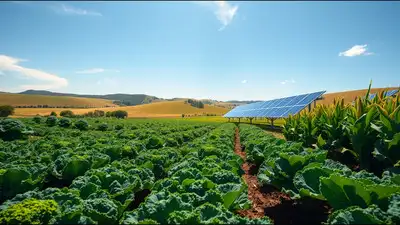
Representative Image of a lush farm scene with solar panels overhead, showcasing broccoli and sweet corn growing below (AI Generated Image)
Farmer Joe Czajkowski, whose family has farmed in the Pioneer Valley for three generations, hosts an 832-panel agrivoltaic array covering 2.2 acres of his more than 400-acre farm. The 445-kilowatt DC system was built by Hyperion Systems and completed in July 2023, although the array became operational in 2024. The North American Agrivoltaics Awards has named Czajkowski its 2026 Solar Farmer of the Year, with the awards ceremony scheduled for October 27 in Chicago. The awards say half the electricity generated by the array runs his farm operations, while the other half goes to 17 low-income households across western Massachusetts. Department of Energy says the panels are mounted at a 10-foot elevation to allow enough sunlight to reach crops below. Hyperion’s project information says the array has a capacity of 445 kilowatts DC and 375 kilowatts AC and consists of 832 modules mounted on single-axis trackers. The rows are spaced 26 feet from post to post, allowing farm equipment to operate between them. The modules are 10 feet above the ground when horizontal, according to Hyperion. The UMass research summary records a maximum tilt that brings the panels to about 7.75 feet above the ground. The UMass research records the system as completed in July 2023. Broccoli was selected for a 2023 experiment examining how the agrivoltaic array affected the crop’s growing conditions. Researchers transplanted broccoli on August 18, 2023, and monitored three bed positions beneath the array: one under the leading panel, one between two panels and one near the back panel. One important detail is that the 2023 trial took place before the system was connected to the grid.
Because the system tracks the sun, the clearance changes as the panels tilt.
The researchers described the findings as a snapshot of how the panels modified the crop-level microclimate and said further time-series analysis was planned. The UMass report says the panels remained horizontal during that trial year, so those results describe the conditions during that specific experiment rather than the fully operational tracking configuration. On a stretch of farmland in Hadley, Massachusetts, broccoli, sweet corn and other crops have been grown beneath rows of solar panels. The U.S. UMass research and project materials from Hyperion describe the tracking system and its changing clearance above the ground. Czajkowski can continue using tractors and attachments for activities including subsoiling, tilling, harrowing, cultivating and spraying. The array uses a north-south single-axis tracking system, with the modules following the sun from east to west. The UMass research summary, titled Broccoli Production Under Agrivoltaic Solar Array in Hadley, MA, describes the work as first-year preliminary results. They compared these positions with control plots. The study examined growing conditions and crop performance at the different positions beneath the array. The researchers found that the leading-panel position received less photosynthetically active radiation than the control, while the other two positions received similar light levels to the control. Air temperature, relative humidity and soil temperature were similar between the array and control areas.
The National Renewable Energy Laboratory identified 566 U.S. agrivoltaic projects as of August 2024, with more than 10 gigawatts of combined capacity. Department of Energy’s Solar Futures Study projected that solar could require about 5.7 million acres of land by 2035, equivalent to roughly 0.3% of the contiguous United States.
Czajkowski told the Department of Energy that the solar income could provide another layer of financial security as he gets older. He also discussed additional agrivoltaic projects as a way of helping keep the farm viable for the next generation. The Hadley project is part of a wider expansion of agrivoltaics in the United States. The figure comes from research published when the laboratory was still known as the National Renewable Energy Laboratory (NREL), now the National Laboratory of the Rockies. The U.S. DOE has highlighted agrivoltaics as one approach to combining solar generation with continued agricultural use of land. Its research and funding programmes have also examined how solar installations can coexist with crops and livestock.