
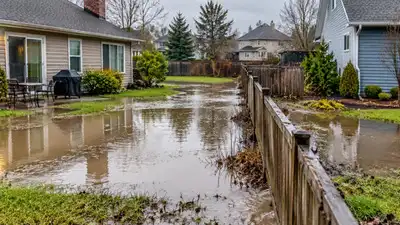
Both sides challenged the court’s decisions on expert evidence and the drainage plan. (Representational AI image)
Beginning of the dispute
Their dispute eventually reached court, where a jury awarded $85,000 to William Michael Coan and Cindy Plant and $91,250 to their neighbour, Robert Ercolani. Coan owned a property at number 800 and shared ownership of another property at number 790 with his girlfriend, Plant. Ercolani owned number 796, located between the two. The flooding mainly affected the properties at numbers 800 and 796. They were awarded $85,000 for damage to property other than trees. Ercolani was awarded $91,250. For that violation, he had been fined $2,900. After legal fees were added, the amount reached $8,147.50.
Because even alterations to ground levels can affect where rainwater collects and how it moves, these changes became important. Because he was tired of the flooding, ercolani said he had built a raised earth barrier to protect his land. The court therefore wanted a drainage arrangement that could work with minimal involvement from either side.
The properties had largely been free from flooding before Coan and Plant acquired their land, according to the judgment . Two neighbours in Michigan, United States, spent years fighting over water flowing between their properties, with each accusing the other of causing flooding and damage. The disagreement unfolded along North Latson Road in Livingston County. However, the neighbours disagreed about what caused the problem to begin. Over time, both Coan and Ercolani changed parts of their properties, including raising or lowering sections of the ground. What might have been a disagreement over drainage turned into years of court proceedings where both sides accused the other of allowing water to enter their land. A major part of the disagreement concerned changes made to Coan’s property. Ercolani maintained that his land had not flooded before work began on the neighbouring plot. He alleged that changes to the ground had caused water to flow towards his property. There were also accusations that water had been pumped across the boundary. During the proceedings, an engineer examined soil samples, aerial photographs and maps showing the ground levels. The evidence indicated that additional soil had been placed on Coan’s land, changing the way surface water moved. Witnesses also described seeing Coan pump water towards the neighbouring property. But Coan and Plant had complaints of their own. They accused Ercolani of causing water to enter their property and sought compensation for the damage. With both sides blaming each other, the dispute eventually reached a jury. When the jury considered the evidence, it did not hold only one side responsible. On one hand, it found that Ercolani had caused damage to Coan and Plant’s property through water entering their land. On the other hand, the jury also found that Coan had caused damage to Ercolani’s property. Plant was found to have allowed water to enter Ercolani’s property unlawfully, but the jury concluded that her actions had not caused damage. The jury also examined whether either side had acted negligently. It found that Coan and Plant had not been negligent. Ercolani was found negligent, but the jury decided that his negligence had not directly caused the damage claimed against him. The result was that both sides received substantial compensation, although neither succeeded on every claim. Yet the money did not solve the problem that had brought them to court. Water still needed a route across the properties, and the neighbours could not agree on how to manage it. Both sides suggested their own ways of dealing with the water. The judge, however, was not satisfied with either proposal. Instead, the court asked an independent expert, Wayne Perry, to examine the situation and recommend a solution. Perry proposed several measures, including areas where water and sediment could collect, changes to the slope of the land and underground pipes to carry water between the properties. His proposal also included a French drain, an underground drainage system that allows water to move through a channel beneath the ground. There was another difficulty. The neighbours had been involved in a long and bitter dispute, making a solution that depended on their cooperation difficult to manage. It selected Perry’s proposal, finding it more suitable than the alternatives. Neither side was satisfied with every aspect of the decision, and the drainage plan became another issue in their appeals. The neighbours challenged several parts of the trial court’s rulings, including the handling of expert evidence and the choice of drainage plan. The appeals court rejected his challenge to that decision. It also found no reason to overturn the drainage plan selected by the trial court. You use AI every day. Now get your AI Quotient. Take the AIQ test.
The engineer found that some water which had previously collected on Coan’s property was instead being directed towards Ercolani’s land. The judge concluded that the land had changed so much over the years that returning it to its earlier condition was no longer practical. Ercolani also disputed an earlier finding that he had violated a court order restricting him from pumping water onto neighbouring land. After reviewing the arguments from both sides, the Michigan Court of Appeals upheld the earlier decisions in full.
Both sides challenged parts of the earlier court decisions, but on Tuesday, the Michigan Court of Appeals upheld the rulings, including the compensation awards and a plan to improve drainage between their properties.