
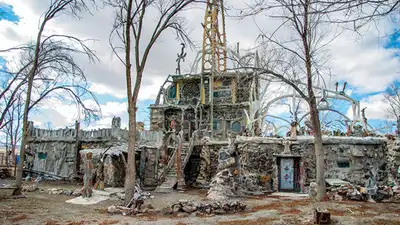
Van Zant used whatever materials he could find, fitting discarded objects into walls, windows and decorative features. Old bottles became part of the walls, creating colourful patterns when sunlight passed through them. (Image Credit: Sally Hanrahan via Travel Nevada)
Just off Interstate 80 near Imlay, Nevada, a five-acre roadside attraction showcases an unusual collection of concrete structures and sculptures made from discarded bottles, car parts and scrap metal. Van Zant started building Thunder Mountain Monument in 1969, using materials such as old bottles, scrap metal and car parts to create a home and a tribute to Native American history, according to Travel Nevada. In 1968, he travelled east from California with his wife.
Their truck broke down near Imlay, a small settlement between Lovelock and Winnemucca, according to Travel Nevada’s account. What looks like a giant artwork made from discarded objects began as the personal project of Frank Van Zant, better known as Chief Rolling Mountain Thunder. Over the following decades, the site grew into a five-acre collection of handmade structures that visitors can explore for free during daylight hours. Van Zant’s journey to Nevada was not originally a plan to build a desert monument. A World War II veteran, he had worked as a deputy sheriff and later for the US Forest Service, where he collected artefacts he found while preparing maps. Thunder Mountain took shape through improvisation rather than formal architectural plans. Van Zant used whatever materials he could find, fitting discarded objects into walls, windows and decorative features. Old bottles became part of the walls, creating colourful patterns when sunlight passed through them. Car parts, hubcaps, windshields, railroad materials and scrap metal were incorporated into the structures. Concrete held many of these objects together, giving the buildings their distinctive appearance. Travel Nevada’s account describes how Van Zant could turn an unwanted typewriter into a design feature or arrange bottles to form a makeshift stained-glass window. Objects that might otherwise have been thrown away became part of the monument’s architecture. The result was not a carefully planned building in the conventional sense. Its unusual appearance reflected the materials available and Van Zant’s changing ideas as construction continued.