
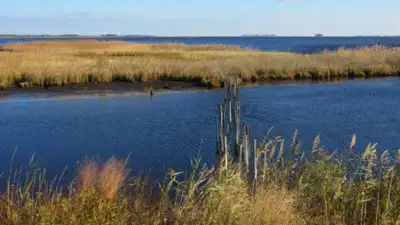
Chesapeake Bay (Image Credit: iStock)
The refuge occupies the northern half of Smith Island, about 11 miles west of Crisfield, Maryland, along with Watts Island farther south in the Chesapeake Bay. When Martin donated the property in 1954, the goal was no longer simply to preserve land for private recreation. Clapper rails, seaside sparrows and marsh wrens depend on the marsh habitat, while peregrine falcons have nested at the refuge since the installation of a nesting tower in 1984.
Its landscape is dominated by tidal marsh, with a network of creeks and coves, freshwater potholes and slightly elevated ridges supporting shrubs and trees. Offshore shallow waters also contain submerged aquatic vegetation, which provides an important food source for waterfowl. The newly established refuge was intended to provide habitat for wildlife, particularly birds that depend on the Chesapeake Bay during migration and winter. The refuge’s marshes and protected waters make it particularly valuable to migratory birds. The U.S. Fish and Wildlife Service describes the area as an important resting and wintering site for thousands of waterfowl. Winter visitors include black ducks, pintails, mergansers, long-tailed ducks, scoters, buffleheads, Canada geese and tundra swans. Historical records show that wintering waterfowl populations at the refuge could be substantial. These populations illustrate why protecting the marsh and surrounding shallow waters became an important part of refuge management. The habitat is not only important in winter. During spring and summer, marsh grasses, insects and underwater vegetation attract ducks including black ducks, mallards, gadwalls and green-winged teal for nesting. Gulls, terns, black skimmers, American oystercatchers and willets also use the marshes, mudflats and sandbars. The marshes are home to mammals including red foxes, muskrats, mink, otters and voles. Northern diamondback terrapins and various nonvenomous water snakes also inhabit the area.
The refuge has historically supported large numbers of wintering waterfowl, including ducks, Canada geese and tundra swans.
Smith Island was explored and charted by Captain John Smith in 1608, while settlers later raised cattle on parts of the island. The refuge is therefore part of a much larger ecological system in which wetlands, shallow waters, vegetation and wildlife are closely connected. The conservation value of Martin National Wildlife Refuge extends beyond birds and land animals. Its marshes and estuarine waters contribute to the Chesapeake Bay food web, supporting marine organisms such as crabs and oysters. The land also carries a long human history. For more than three centuries, island communities have depended on Chesapeake Bay resources, particularly oysters and crabs. Evidence of old livestock corrals and low dikes built to hold back tides remains visible in parts of the landscape.