
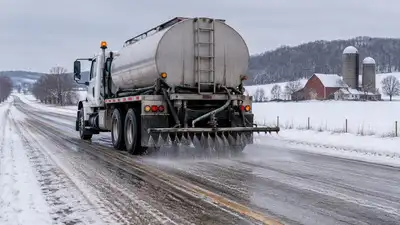
AI Representation: Wisconsin’s 2008-09 cheese brine experiment proved that dairy waste could help fight icy roads. Image credits: Wikimedia Commons
The eutectic composition of a sodium chloride brine is about 23% salt by weight, and a brine at that concentration freezes at about −6°F (−21°C), according to the Federal Highway Administration . Norby left 12 ounces of the brine outside and found that it did not freeze until after two consecutive days at −21°F, a result colder than the −6°F limit for sodium chloride brine, so it is best read as an informal observation. Emil Norby told The New York Times that dry road salt can lose about 30% of its material to bounce and traffic, a figure consistent with a Michigan Department of Transportation study that found roughly 30% of dry salt is lost to bounce and scatter. What the brine cost compared with magnesium chloride Magnesium chloride would cost $1.29 a gallon, ForConstructionPros reported, while hauling the brine himself would cost just 9 cents a gallon, saving the county $40,000 in its first year. Sources differ on what the $40,000 figure represents: ForConstructionPros ties it to replacing magnesium chloride, while The New York Times, as relayed by Sustainable Brands, describes it as $40,000 saved on rock salt, so it is best read as one reported saving whose basis is unclear. Chuck Engdahl, wastewater manager at F & A Dairy Products, said the company saves roughly $20,000 per year by giving excess cheese brine to road crews instead of paying to haul it away for disposal. Milwaukee’s 2013 pilot and the limits of the idea It was said that Milwaukee was the largest city to test the cheese brine for road deicing, and Modern Farmer reported that if the test succeeded, it would be the largest city to use the solution. Farm and Dairy, citing the Times, mentions that the city used 44,000 tons of salt in 2012, which cost the city $6.5 million in terms of dealing with snow and ice. At the same time, it was estimated that the pilot would cost only around $6,500. Why less salt matters for lakes: the 2017 findings Chloride does not disappear after the snow melts. The Cary Institute reports that the 2017 study Salting our freshwater lakes found long-term salinization in 44% of sampled lakes in the Midwest and Northeast; impervious land cover was the key predictor, and even 1% development around a lake increased the odds of long-term salinization.
Because it serves as a primer so that roads require less of it, huffPost also highlights that the brine will not substitute for salt. The same study reported that pre-wetting salt with brine significantly reduces those losses. The brine’s main function is pre-wetting, which coats the rock salt before it is spread. The dairy made some profit as well. The Times further reports that the pilot involved only eight gallons of brine per ton of rock salt, and the Associated Press also mentions that the city was going to find a provider of mozzarella or provolone brine. Road salt lowers the freezing point of water to help prevent ice and snow from bonding to pavement. Image credits: Wikimedia Commons This method has its disadvantages. Norby described the brine’s smell as mild, and Milwaukee’s Department of Public Works describes it as having “a distinctive odor. Nonetheless, cheese brine still deposits sodium chloride, and consequently chloride, into the environment. The advantage is only the lesser quantity of salt. Cheese brine still deposits sodium chloride, so its benefit is applying less salt overall. You use AI every day. Now get your AI Quotient. Take the AIQ test.
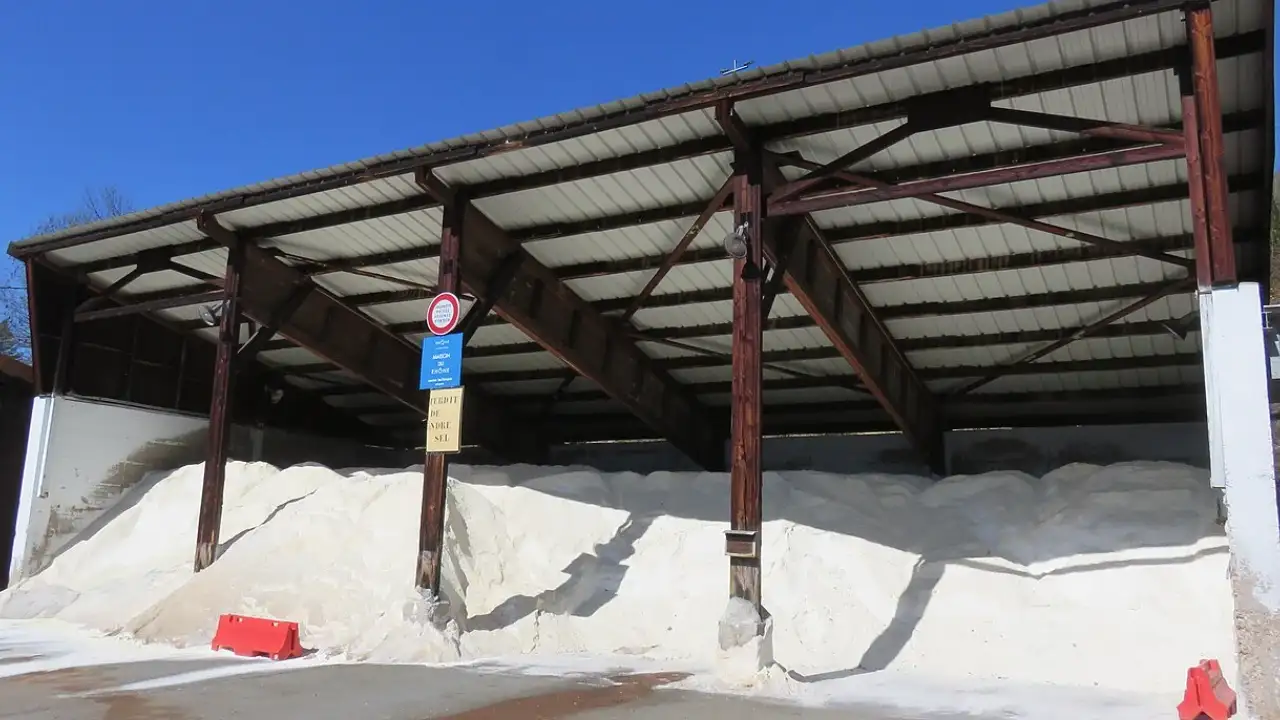
Norby conducted a study on test roads during the 2008 to 2009 winter. NPR reported that, depending on the amount of material applied, the study found salt savings of 30 to 40%. Minnesota Public Radio reported that the 2008-09 findings led the county to use the brine more widely, and NPR noted in January 2014 that the county had put down 38,000 gallons of it the winter before. A field test and the −6°F freezing limit of salt brine
Minnesota Public Radio reported that the test roads let Norby compare ordinary salt with the cheese-brine mix under real winter conditions, and that the brine helped the salt stick to the pavement instead of bouncing off. Norby also reported better results at colder temperatures, which let the county use less salt and stretch its supply.
Emil Norby’s brine trial in Polk County Emil “Moe” Norby of the Polk County Highway Department started the project in 2008, inspired by the fact that dairies soak cheese in brine, as ForConstructionPros reported. The point, Norby later said, was to see whether a waste stream from cheesemaking could do the same job for less money. Wisconsin is one of the biggest cheese-producing states in the country, and it also has long, hard winters that keep highway crews working through the night. Wisconsin’s dairies and its highway departments seem to have little in common, but both handle large amounts of salt. Some of the brined cheeses, like mozzarella or provolone, are treated with brine or salty liquid. The brine has to be disposed of, which costs the dairy money. Road crews spread salt on roads, but a significant portion does not stay in place. Instead, it can bounce off the pavement or be scattered by passing traffic. To address this problem, one rural county decided to try an unconventional solution. The brine came from F & A Dairy Products in Dresser, Wisconsin, which turns out thousands of gallons of it each year.
The brine is filtered before the county picks it up.