PC: Scenic Hudson
A former precision-tool factory in Poughkeepsie, New York, spent years standing unused before a $43.7 million redevelopment gave the ageing industrial site a new purpose. The property, once home to the Standard Gage factory, has been transformed into the Northside Hub, a solar-powered campus combining offices, community facilities and public green space. Environmental nonprofit Scenic Hudson led the five-year project, which retains the site’s industrial history while introducing rooftop gardens, solar panels and areas for local gatherings. More than a headquarters, the development opens part of the former factory site to businesses, community organisations and residents, bringing new activity to a long-neglected property.
The redevelopment unfolded over five years, with a reported investment of $43.7 million, as reported by WAMC Northeast Public Radio. The site began welcoming the public through a community block party held on 10 October 2025. Scenic Hudson staff had moved into the headquarters in September that year, and the organisation planned for the campus to open permanently to the public in January 2026.
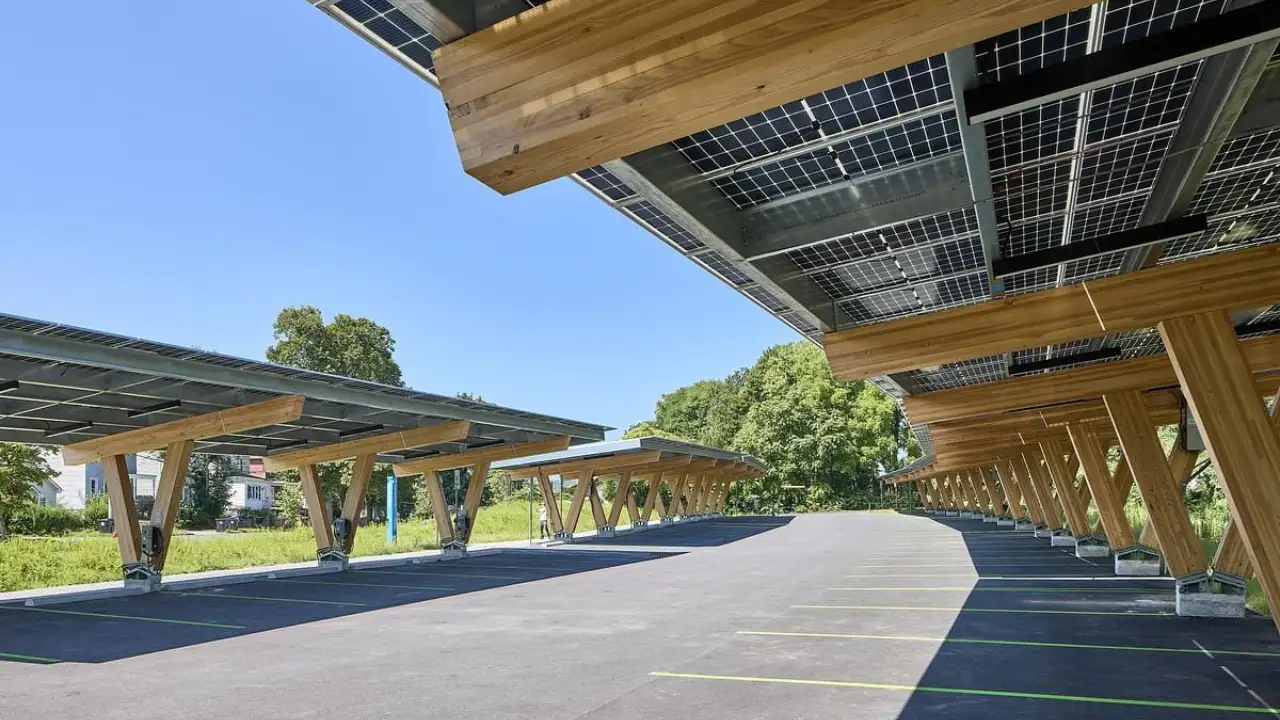
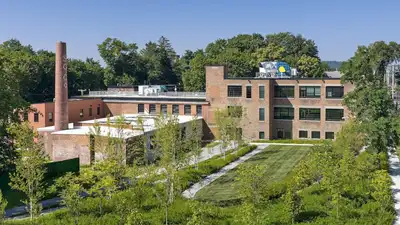
The Northside Hub occupies the former Standard Gage factory, a 20th-century manufacturing property in the north of Poughkeepsie. Like other industrial buildings in older American cities, the site had reached a point where its condition made its future uncertain. Its ageing structures and brownfield setting presented challenges, but the property also offered an opportunity to reuse land that had already been developed rather than expand into undeveloped areas. Scenic Hudson, the Poughkeepsie-based environmental organisation behind the project, took on the task of bringing the property back into use. The intention was to create a permanent base for the nonprofit while making the wider site useful to the surrounding community. The approach reflects a practical question facing cities with a long industrial history: what should happen to factories and commercial buildings once their original purpose has disappeared? Leaving them unused can allow deterioration to continue, while demolishing them and starting again can mean losing existing structures and consuming additional resources. At the Northside Hub, the decision was to adapt the site for a mixture of work, public activities and outdoor use. Scenic Hudson’s offices occupy part of the renovated complex, but the building has not been designed exclusively for its employees. More than one-third of the Northside Hub is intended for lease to businesses and community organisations, giving other groups a place to work and hold activities. Inside, the facilities include an auditorium, meeting rooms, office accommodation and spaces available for rental. These areas can serve different purposes throughout the week, from organisational meetings to larger gatherings and community events. The outdoor areas are another part of the development. A park and pavilion provide places for people to meet, while the building’s rooftop includes planted areas overlooking Fall Kill Creek. The landscaping incorporates native grasses and sedum, plants suited to the roof environment and capable of helping manage rainwater. Families, children and local organisations attended, with activities taking place around the new park and pavilion. Energy generation is built into the Northside Hub’s design. Solar panels sit on the roof and above sections of the car park, where timber canopies support the installations and provide shade for vehicles. The arrangement allows the project to use both the building and its surrounding paved areas to generate electricity. The organisation describes the campus as a net-zero development. Its renewable energy system forms part of a wider design that incorporates planted roofing, outdoor green space and stormwater management. The roof vegetation helps absorb and manage rainfall, reducing the amount of water that runs directly off the building. PC: Scenic Hudson These features give the project an environmental role beyond its use as an office complex. Its value, however, rests on more than the installation of solar panels. The building also has to accommodate daily work, community use and the upkeep of its public areas. The combination of solar infrastructure and shared facilities makes the Northside Hub an example of how an older industrial property can be adapted to meet several needs at once. Its design does not depend on turning the site into a conventional office building or a park alone. Scenic Hudson has spent decades working to protect the Hudson Valley’s landscapes and outdoor spaces. The Northside Hub’s principal architect, Justin Brown, has pointed to the potential of ageing industrial buildings in smaller post-industrial American cities. Such properties can be difficult to restore, particularly when roofs and other parts of the structure have deteriorated. Yet their existing buildings and locations may still offer opportunities for new uses. The Standard Gage factory provided that starting point. Instead of treating the property solely as a problem to be cleared, the redevelopment made its existing industrial character part of a new campus. The project also creates space for organisations beyond Scenic Hudson, allowing the site to function as a local resource as well as an administrative base. Its offices provide a home for Scenic Hudson, its rentable areas offer space for other organisations, and its park, pavilion and rooftop planting introduce public and environmental features into the former industrial property. The building’s new role is different from the one for which it was constructed, but the site remains in use and has been adapted to support a range of activities. The project does not remove every challenge associated with redeveloping an old industrial property. It does, however, demonstrate what can be achieved when rehabilitation, renewable energy and community facilities are planned as parts of the same development. The former Standard Gage factory now serves as a workplace and gathering place, with its solar-powered systems and planted outdoor areas integrated into the wider site. For Scenic Hudson, the Northside Hub is both a headquarters and a working example of its approach to the built environment: making use of existing urban land while creating room for people and nature. You use AI every day. Now get your AI Quotient. Take the AIQ test.
The redevelopment brings a previously developed property back into service while incorporating energy generation and landscaping into the site. Reusing an industrial site in Poughkeepsie offers a way to apply that environmental outlook within an established urban area, where vacant buildings and previously developed land can present alternatives to building on undeveloped ground. The Northside Hub brings several functions together on land that had previously stood underused. For Poughkeepsie, the redevelopment also gives a historic factory a continuing place in the city rather than leaving it as a remnant of an earlier manufacturing era.