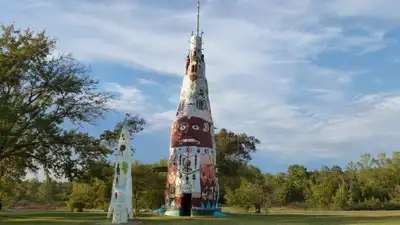
Representative image of Ed Galloway’s Totem Pole Park. (Image Credits: Wikimedia Commons)
In 1937, Nathan Edward Galloway retired and settled on a property in Oklahoma and began creating a collection of folk-art structures which would eventually be known as Ed Galloway’s Totem Pole Park. Located near Foyil in Rogers County, the park, managed by the Rogers County Historical Society, features a 90-foot-tall totem pole made out of sandstone, wood, steel, and concrete. The construction took place from 1937 and continued to 1961,with the totem pole being realised between 1937 and 1948, according to the National Park Service . The site serves as a historic attraction along Route 66 and has been listed on the National Register of Historic Places. Galloway spent 11 years constructing the 90-foot totem pole National Park Service records show that Galloway was born in Springfield, Missouri, in 1880, and as a young boy became a wood carver, an interest that eventually developed into a talent for woodworking and blacksmithing. His totem pole, which took over 11 years of work, became the largest artistic structure on the property. Each of the designs is arranged in a way that faces the four cardinal directions, and as per the account of FolkArtwork, there are 200 carved images across the main structure; these are mainly portraits, symbols, and animal figures. Galloway pursued the development of the park until he passed in 1961, after which the site fell into a state of disrepair. The Rogers County Historical Society acquired the property in 1989 and, in a joint effort with the Kansas Grassroots Arts Association, undertook the restoration work.
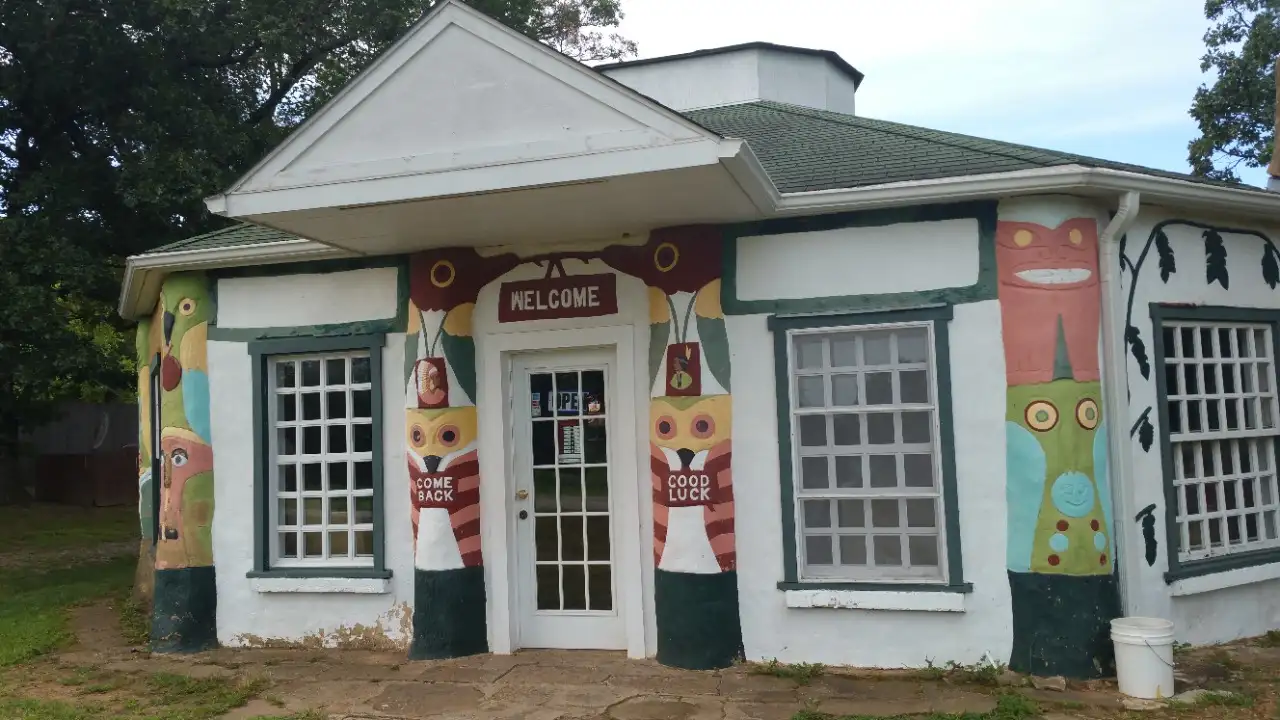
The restoration work included repainting, replacing deteriorated materials, and replicating elements that could no longer be preserved, according to the National Park Service. The structure was made tangible through Galloway’s woodworking skills, led by his personal interest in decorative art. His early experience found him working at Sand Springs Home in Oklahoma, where he taught orphan boys manual arts. After his retirement, he moved to the property that became the park; he built a smokehouse, a workshop, and made violins, furniture, and decorative wall art. The inspiration for the totem pole stemmed from Galloway’s own personal interest in Native American art, and he used postcards and National Geographic magazines to draw out his ideas. The pole is made from steel, wood and concrete, while its exterior is thick with red sandstone, and its carved bas-reliefs are decorated with birds and Native American figures. The structure rises from the back of a large, three-dimensional turtle carved from a sandstone outcrop on the property. Inside, the hollow tower ascends through nine levels, with the ground floor measuring nine feet in diameter. Painted murals depicting mountain-and-lake scenes and bird totems decorate the plastered interior. Native American shields and arrow points appear above the murals, while the cone at the top remains open to the sky. Excluding the structures, other designs of Galloway extend through the grounds, and the National Park Service has identified them as an Arrowhead Totem, a Birdbath Totem, and a Tree Totem. In addition, the park also has concrete picnic table totem designs, a barbecue fireplace, and fish-shaped gate structures. Representative image of the Fiddle House. (Image Credits: Wikimedia Commons) The Fiddle House preserves Galloway’s other creations Beyond the outdoor monuments, the property houses an eleven-sided building known as the Fiddle House, which resembles a Navajo hogan embellished with totemic columns and Native American portraits. FolkArtwork adds that Galloway used wood that his former students from different parts of the world had sent to create the wooden fiddles. You use AI every day. Now get your AI Quotient. Take the AIQ test.