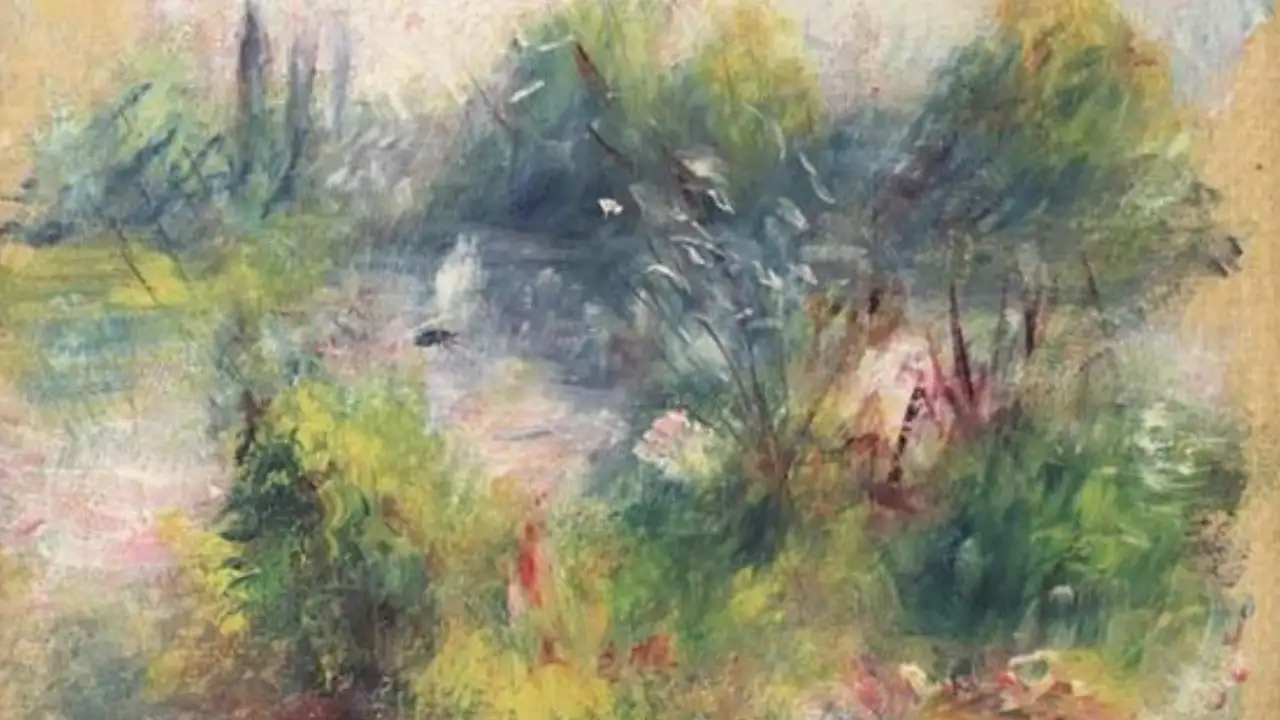
The work, also known as On the Shore of the Seine, was painted by Renoir in 1879. Image Credits: Wikimedia Commons.
A trip to a flea market led to an unusual case of art ownership when a woman from Virginia realised that she had bought a small painting by French Impressionist painter Pierre-Auguste Renoir. What was initially something like an inexpensive acquisition at a thrift store became part of a federal lawsuit involving the Baltimore Museum of Art. The painting’s path from a West Virginia flea market to a Virginia courtroom raised the question of whether an innocent purchase can establish ownership rights.
The painting Paysage Bords de Seine had been stolen from the Baltimore Museum of Art in November 1951, according to the US Department of Justice . Martha Fuqua, a resident of Lovettsville, Virginia, alleged that she bought the painting from a flea market at Harper’s Ferry for only $7 in 2009. The painting came to light when Ms Fuqua tried to auction it in 2012. Museum records and a police report linked the painting to the Baltimore Museum of Art, which asserted ownership under federal law on January 10, 2014. A $7 discovery with an extraordinary history The work, also known as On the Shore of the Seine, was painted by Renoir in 1879. It is a miniature landscape that measures roughly 5.5 by 9 inches and was painted in oil on linen. May of Baltimore, who purchased it from a Paris gallery in 1926. Afterwards, it was loaned to the Baltimore Museum of Art by her in 1937 under the terms of her will, and it belonged to the Museum even after her death. The painting was stolen during an exhibition at the Museum in November 1951. The painting drew attention in September 2012 after Fuqua contacted the Potomack Company, an auction house in Alexandria, Virginia, to sell it. The painting was valued at about $75,000, but the estimates were higher. Later, the theft report made in 1951 was found, which confirmed that the painting had been stolen from the museum. The FBI seized the painting in October 2012, stopping the auction process. The recovered Renoir painting, Paysage Bords de Seine (1879), is an Impressionist landscape that was stolen from the Baltimore Museum of Art in 1951 and later discovered at a flea market. In the ruling issued on January 10 2014, Judge Leonie Brinkema ordered judgment in favour of the Baltimore Museum of Art as there was enough evidence to prove the ownership of the museum.
It came along with other items such as a doll and a plastic cow; therefore, she had not known the value of the painting at the very beginning, even though it had an identification tag from Renoir. Therefore, the Renoir scandal suggests that it is necessary to maintain historical documentation records, especially in situations where artworks are being traded without proper gallery or auction channels. The loss took on special importance once the Museum realised that the documents regarding loans highlighted the connection of the lost artwork with the collection of May. With the ruling, the museum was poised to reclaim its lost piece of art.
It was executed on a napkin at one of the restaurants on the riverbank in France, according to a PRWeb release announcing the museum’s exhibition. The painting was part of the collection of Saidie A. How the theft came to light decades later Fuqua explained that she had seen the painting but was supposedly more interested in its elaborate framing than the actual painting. She found the painting in a box of miscellaneous items at a flea market. The Baltimore Museum of Art began researching its archives and found evidence that the painting had been on loan to the museum since May. Image Credits: Wikimedia Commons. District Court for the Eastern District of Virginia. Fuqua claimed that she was an innocent buyer and was entitled to keep the painting. However, the court stated that even when a purchase is made in good faith, it could not overcome the documented ownership of stolen property. Notably, the judge did not make any pronouncement on the truthfulness of the account of the flea market purchase by her. The ruling closed a dispute that had gone public in the country and made it clear that just a purchase does not imply ownership. Thus, for the Baltimore Museum of Art, this verdict brought back the painting that was missing for more than sixty years. You use AI every day. Now get your AI Quotient. Take the AIQ test.
Before the auction took place, there were some doubts about the painting’s ownership history. A federal judge settles the ownership dispute This matter finally came before the U.S.