
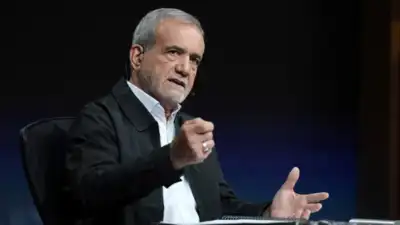
Pezeshkian said the world recognised what he described as Iran’s victory
Iranian President Urges End to Conflict with U.S. Amidst Diplomatic Stalemate
Iranian President Masoud Pezeshkian has called for an immediate cessation of the ongoing war with the United States, asserting that Iran currently holds a position of strength and dignity. His comments came during a meeting with medical professionals on Friday, as reported by Al Jazeera.
Pezeshkian emphasized the need to end hostilities, stating, “It is better that we bring the war to an end now as we are in a position of power and dignity.” He claimed that the global community recognizes Iran’s resilience, while accusing the U.S. of violating international norms by attacking Iranian schools, hospitals, and infrastructure.
“The whole world acknowledges our victory and emphasizes that America has attacked our schools, hospitals and infrastructure in violation of all regulations and is hated around the world,” he stated.
These remarks follow the expiration of a memorandum of understanding between Tehran and Washington, which has not resulted in any significant diplomatic progress towards resolving the conflict.
Iran’s Parliament speaker has previously said Tehran would not reopen the strait until Washington meets commitments under a 14-point memorandum, including lifting the blockade, releasing frozen Iranian assets and easing oil sanctions.
Asked whether US military options against Iran were limited, Trump said, “It just means that we’re seeing what happens. So, they would love to make a deal, but they’re not ready to make the right deal, in my opinion,” Trump said. Bessent has said Washington would impose the “toughest sanctions in history” and sought China’s cooperation in increasing economic pressure on Tehran. China has rejected the approach, with its foreign ministry saying that “sanctions and pressure will not help resolve the issue” and calling for political and diplomatic efforts.
“We have total control of that entire region having to do with the Strait of Hormuz, and that means well into it, the land areas. Meanwhile, US President Donald Trump said on Friday that Washington was watching developments in the conflict and suggested Tehran was not ready to accept what he considered an appropriate agreement. The comments came ahead of a planned announcement by US treasury secretary Scott Bessent on Monday on new sanctions against Iran.
Pezeshkian defends US deal as Iran’s military warns of retaliation
US energy secretary Chris Wright said the US military had helped move a seven-day average of about 8 million barrels of oil a day through the waterway, down from more than 20 million barrels per day before the conflict. “14 years ago: ‘Most crippling sanctions in history. 8 years ago: ‘Maximum pressure. 5 months ago: ‘Unconditional surrender.
All the commitments concern the other side,” he said. “With preparedness across land, sea, air, air defence and cyberspace, Iran’s armed forces will respond to the enemy’s new threats with crushing, punishing and devastating responses,” Abdollahi said. IRGC chief Ahmad Vahidi also said Iran had created a “solid defensive shield” against threats and called continuation of its “Strategy of Defensive and Offensive Empowerment” the only “intelligent and efficient solution”, as reported by Al Jazeera. “No matter how much military power we have, we won’t survive if people are hungry and we don’t have financial turnover, economic growth and national production,” he said, according to Iran’s official IRNA news agency, as cited by Reuters. They also discussed developments affecting navigation in the Strait of Hormuz, according to Al Jazeera. The Strait of Hormuz handled about one-fifth of global oil and LNG supplies before the war, according to Reuters. Different bullies,” Araghchi said in a post on X. Iran’s foreign ministry has separately accused Washington’s planned measures of being “economic terrorism”, while a ministry spokesperson described possible secondary sanctions as an assertion of “extraterritorial sovereignty” over independent UN member states.
Pezeshkian also defended the June memorandum of understanding with Washington against criticism from hardliners in Iran’s parliament, who had accused his administration of making concessions to the US. “They cannot find even a single clause in this agreement that indicates capitulation. However, Iran’s military leadership has continued to signal readiness for further conflict. Major-General Ali Abdollahi, chief of staff of Iran’s armed forces, was quoted by Iranian media as saying the country’s forces would respond to new threats. Meanwhile, Iranian Parliament Speaker Mohammad Bagher Ghalibaf has acknowledged the pressure on the country’s economy. The waterway remains at the centre of the confrontation. Iran has kept the strait partially shut while the US maintains a naval counterblockade. Iran has also criticised the planned sanctions. Foreign minister Abbas Araghchi described the campaign as a continuation of failed US pressure policies. Failed. Bound to fail. We have seen this movie before. Same bull. Catch the latest World News and Live updates. Download the TOI app.
Omani and Iranian foreign ministers discussed ways to create conditions for resuming dialogue and negotiations during a phone call on Friday, according to Oman’s state news agency. Traffic through the strait has been severely disrupted, with only four commodity ships crossing on Thursday and none of them large crude carriers or LNG tankers, according to ship-tracking data. Today: ‘Most crushing economic operation ever.