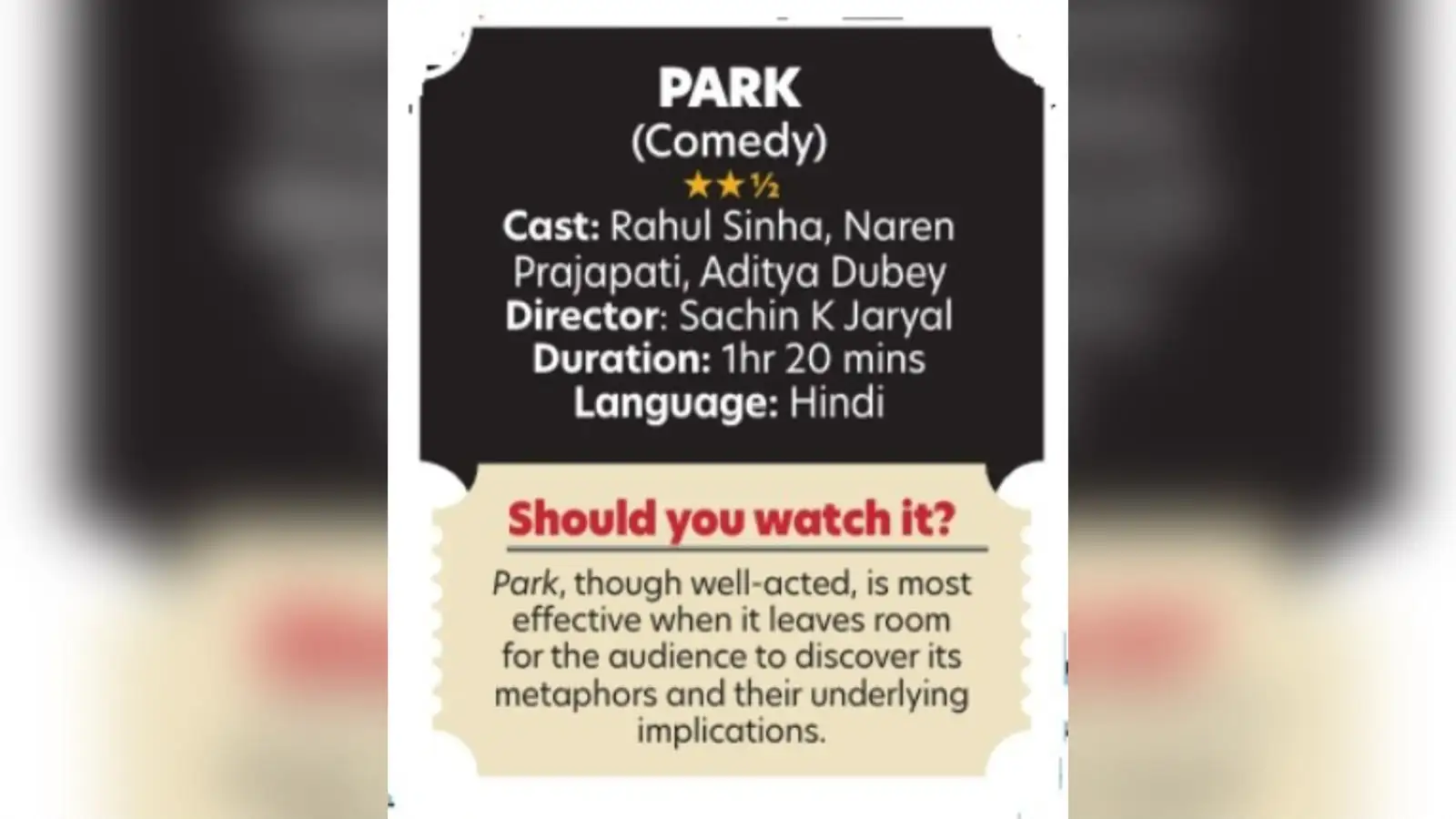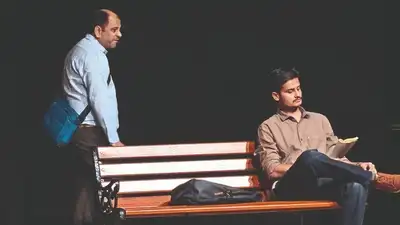
A still from Park
For the first few seconds, the audience barely hears anything beyond his increasingly frustrated “Hello”. Reminiscent of American playwright Edward Albee’s work The Zoo Story , Park , written by Manav Kaul , takes an ordinary public space – a bench – and turns it into a metaphor for deeper questions of identity and belonging. The almost absurdist opening of the play immediately draws your attention. A man enters, speaking on the phone to his doctor. The tension begins when a second man enters and starts wrestling, first verbally and then physically, for the bench. He insists it is where he sleeps every afternoon. The younger man, who arrived first, argues that the bench is public property and belongs to no one. Eventually, they squeeze onto it together, each pushing the other in a ridiculous fight for a few extra inches of space. The physical comedy lands, eliciting some genuine laugh-out-loud moments. Ultimately, the younger man moves to another bench, but his peace is interrupted by a third character – an annoying school teacher. The debate over who the bench belongs to resurfaces, this time between the young man and the teacher. Until this point, the drama has trusted the audience to understand what is unfolding. However, with the introduction of the third character, the dialogue becomes increasingly verbose.
Mail us at [email protected] -Anvita Singh You Can Also Check: Gold Rate in Delhi | Silver Rate in Delhi | Bank Holidays in Delhi | Public Holidays in Delhi | Delhi AQI | Weather in Delhi | Petrol Price in Delhi | Diesel Price in Delhi | CNG Price in Delhi | LPG Price in Delhi Stay updated with the latest Delhi news. There are well made analogies about the bench being like Palestine or Tibet, with the two men trying to take over their respective benches from the younger man being compared to Israel and China. It crosses miles of land to metamorphose into various conflict-ridden places, as the younger man continues to argue his case by drawing parallels to real-world issues. The problem here isn’t the example, but the fact that it is underlined more often than needed. Another grouse with the play is its reliance on music to do much of the mood-signalling. The background score sometimes does too much heavy lifting, which the performances could have been trusted to do. Park stretches at points, especially after the entrance of the third character. The play’s politics is clear as day; if only it were a little sharper and subtler. Want us to review your play? Mail us at [email protected] Want us to review your play? Download the TOI App.