
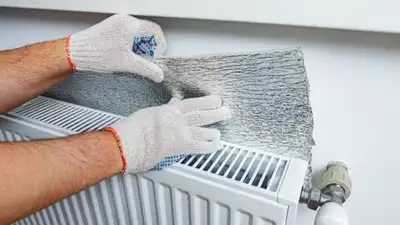
But two of its most talked-about “behind the appliance” uses actually land on completely opposite ends of the usefulness spectrum, and mixing them up could leave you either wasting your time or missing out on a genuinely handy trick. Aluminium foil has become something of a viral fixture in home hacks lately, showing up everywhere from pigeon-proofed balconies to kitchen drawers. Foil behind a radiator sounds like smart, budget energy-saving logic, and foil behind a stove sounds like a straightforward cleaning shortcut, but only one of these actually delivers on its promise the way people expect. Here’s the real difference between the two, and why the physics involved matters far more than the hack itself.
Because the job it’s doing, catching mess, is exactly what foil is naturally good at, it’s a low-tech, genuinely effective solution precisely. Lining the wall or backsplash area directly behind your stovetop with foil isn’t about heat physics at all, it’s simply a disposable barrier catching oil splatters and food residue before they hit the wall. Unlike foil placed on or around an active burner, which genuinely does carry fire and ventilation risks, foil applied to the wall behind the stove sits well clear of any open flame, meaning none of those safety concerns apply here. It’s purely a cleaning shortcut, not an attempt to interact with heat or combustion in any way. Cooking splatters, especially from frying or high-heat sautéing, tend to land on the wall directly behind the stove more than almost anywhere else in the kitchen, and that grease has a habit of baking on and becoming genuinely stubborn to scrub off over time. A sheet of foil taped or pressed against that specific patch of wall means you’re peeling off and replacing a disposable layer every so often instead of scouring tile or paint repeatedly. It’s the kind of hack that sounds too simple to be true, a five-rupee roll of kitchen foil solving a problem that usually means an hour of scraping and swearing at a stuck drawer. As it turns out, foil genuinely does have a legitimate role to play in your freezer, just maybe not in quite the way the viral version of this hack claims. Here’s what actually holds up. Aluminium is an excellent conductor of heat, and its surface is smooth compared to the rougher plastic or metal walls of a typical freezer interior, and ice is generally understood to bond more weakly to smooth surfaces than porous or textured ones. The idea, then, is that lining frost-prone spots with foil sheets gives frost somewhere easier to let go of, so when it’s time to clean, you simply peel away the icy foil instead of scraping directly at the walls. Wrapping food tightly in a sheet of heavy-duty foil, pressing out as much trapped air as possible before sealing it into a flat, compact packet, genuinely slows down freezer burn by keeping air away from the food’s surface. Flatter, air-free packets also tend to freeze faster than bulky, loosely wrapped containers, which helps preserve texture and flavour considerably better once thawed. It’s a simple habit that costs nothing extra and does real, measurable work protecting whatever you’re storing.
Earlier reporting noted: Scroll through enough home hack content lately and you’ll run into some version of this claim: lining your freezer with aluminium foil supposedly stops ice from sticking to the walls, making that dreaded defrosting chore almost effortless. Earlier reporting noted: The reasoning behind the trend isn’t nonsense on its face. Earlier reporting noted: This is the use that holds up without any real debate.