
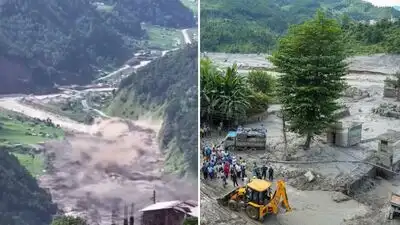
Dam burst in Tibet (representative file photo)
Kathmandu: Nepal’s rescue operations were temporarily halted for 90 minutes on Friday after a landslide-formed lake on the Nepal-China border began overflowing, triggering fears of another surge in the flood-ravaged region. The fresh alert came as a magnitude 5.1 earthquake struck China’s Sichuan province, adding to the mounting challenges facing the disaster-hit Himalayan region. The Nepal Army subsequently suspended rescue operations for one hour and 30 minutes as authorities assessed the threat. By Friday, the reservoir had grown to more than 2.5 million cubic metres, compared with an estimated 1.5 million to 2 million cubic metres a day earlier. The confirmed death toll in Nepal has risen to 469, while almost 1,000 people remain missing in Nepal and Tibet. At least 540 foreigners are among those reported missing.
The rising water also prompted Chinese rescue personnel and vehicles to withdraw to a designated safe area, state broadcaster CCTV reported.
Residents in Rasuwa district, near the border with China’s Tibet, were seen rushing towards higher ground as the river level began rising, according to a Reuters witness. “We can see that the level of water in the river is rising,” Narendra Pariyar, the senior-most bureaucrat in Rasuwa district, said, adding that authorities were still assessing the situation. They are dead,” Tamang said. Despite offers of assistance from several countries, Nepal has said it does not currently require foreign search-and-rescue teams.
Nepal warned rescue teams to move to safer locations after authorities received information that the glacial lake had breached its banks. The lake was formed when debris from the glacier collapse blocked the river, creating a natural barrier and trapping water upstream. The floods swept through villages and valleys, destroying power stations, roads and bridges along a key route connecting Kathmandu with Lhasa in Tibet. The corridor is also popular with trekkers and pilgrims travelling towards Mount Kailash. Emergency workers, including teams using sniffer dogs, had also recovered dozens of bodies swept downstream into the plains. “All of our people have gone. “I have no one left waiting for me. Everything and everyone is gone. The end. “The offer for help is natural. Our security agencies are doing the search and rescue operation.
Authorities fear that a breach could send another powerful surge downstream, threatening communities that are already struggling to recover from the earlier disaster. Before the latest suspension, Nepalese rescue teams had been using helicopters to search for survivors and deliver emergency supplies to thousands of people cut off in towns and valleys. A lake formed by debris from the massive glacier collapse began overflowing on Friday, raising fears of renewed flooding in communities already devastated by Wednesday’s flash floods. China mobilised an eight-member engineering team on Thursday to conduct aerial surveys and three-dimensional modelling of the lake. The latest crisis comes after a huge torrent of rock, ice, mud and debris tore through Himalayan river systems following the collapse on Wednesday. Dibga Tamang was among the last people rescued from Rasuwa on Thursday, when he was airlifted with three others to an army camp in Nuwakot. For now we don’t require such help,” Lok Bahadur Chhetri, spokesperson for the foreign ministry said on Friday.
CCTV reported that 558 people were missing in Tibet’s Gyirong County, including 260 foreign nationals. Adding to the uncertainty in the region, a magnitude 5.1 earthquake struck Longchang City in Neijiang, Sichuan province, on Friday, according to the China Earthquake Networks Center. Because nepal has yet to establish a plan to accept foreign rescue teams, according to South Korea’s foreign ministry, a South Korean rapid response team is already in Kathmandu but has not been deployed.
Three people have been confirmed dead on the Chinese side.
President Donald Trump said the United States had offered assistance to Nepal. The disaster has also caused extensive destruction around the Gyirong border crossing on the Chinese side. Chinese rescuers had yet to reach the worst-hit area as crews worked to clear debris from the access road. Dramatic footage from Wednesday showed torrents of muddy water and debris tearing through structures at the border crossing within seconds. There were no immediate reports of casualties or damage from the earthquake. The fresh seismic event comes as authorities remain on alert across the Himalayan region, where rescue teams are already dealing with unstable terrain, blocked rivers and the risk of further landslides and flooding. The disaster has triggered a desperate search for missing relatives across several countries. Among those unaccounted for are dozens of Americans who had travelled from Nepal towards Tibet’s Mount Kailash. “Nobody’s ever seen anything quite like that, where very powerful, strong, well-built buildings were wiped out like they were toothpicks. It’s a terrible thing. We are sending aid and we’ve spoken to the leadership and we let them know anything they want, they’ll have. Catch the latest World News and Live updates. Download the TOI app.
Chinese Premier Li Qiang visited the disaster-hit area in Gyirong on Thursday as rescue and relief operations continued.