
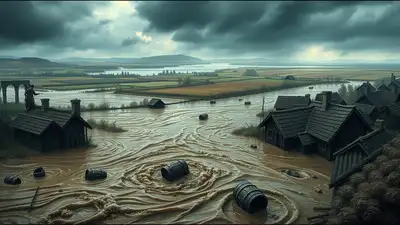
Representative Image of devastating floods sweeping through medieval European towns, bridges, and farmlands in 1342–1343 (AI-generated image)
For centuries, the Magdalena Flood of July 1342 stood out as one of the great flood disasters of medieval Central Europe. A new study published in Nature suggests the disaster was actually part of something much larger: a run of 16 major floods that hit different parts of Europe between late 1341 and 1343. Researchers led by Andrea Kiss, a historian, medievalist and geographer at TU Wien, pieced the sequence together from more than 1,000 entries in contemporary records and other historical evidence. Four of the floods were classified as extreme events, with estimated return periods of 500 to 1,000 years. The researchers found that 1342 had more great and extraordinary floods than any other year in their 700-year European record, while 1343 ranked among the top 10. The idea is not that one volcano directly caused all 16 floods.
The repeated flooding damaged settlements, farmland, roads and other infrastructure, while the disruption contributed to food shortages and wider economic problems. The researchers link the unusual cluster to volcanic activity alongside major changes in the Arctic and North Atlantic climate. The sheer number of major floods raised another question: why did so many occur within such a short period? The researchers looked at climate conditions around the same time and found a possible explanation involving both volcanic activity and changes in the Arctic and North Atlantic. Several eruptions occurred around the beginning of the period, while climate evidence points to significant changes in Arctic sea ice. Instead, the authors propose that a combination of volcanic eruptions and multi-year changes in Arctic sea ice altered atmospheric circulation across the Northern Hemisphere. Those changes may have created conditions that made intense rainfall and flooding more likely in parts of Europe. It is a reminder that extreme weather does not always happen in isolation. Large-scale changes in the climate system can create a period in which several otherwise unusual events occur close together.