
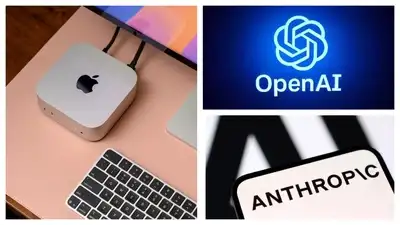
OpenAI has bought tens of thousands of Mac minis and Mac Studios for work involving AI agents and reinforcement learning, while Anthropic has reportedly rented Mac minis through Amazon Web Services for similar tasks, according to a report by The information. Apple’s Mac mini and Mac Studio computers have become increasingly difficult to find in several markets, and the AI boom may be playing a surprising role in the shortage. At the same time, developers and consumers are increasingly turning to Apple’s compact computers to run AI agents locally. The demand has been particularly visible in China, where the popularity of OpenClaw has reportedly pushed Mac mini stocks down and prices up.
OpenAI has spent several months buying tens of thousands of Mac minis and Mac Studios, according to The Information. The Claude maker is said to have rented the machines through Amazon Web Services for similar AI work. The computers are reportedly being used for reinforcement learning and AI agents that can interact with computers. Anthropic has also reportedly been using Mac minis, although through a different route. The demand highlights an unusual role for Apple’s small desktop computers. Macs are not replacing Nvidia’s powerful GPUs for training the largest AI models. Instead, they can be useful for another growing area of artificial intelligence: AI agents that interact with regular computer environments. Such agents can look at a screen, use a browser, click buttons and repeatedly attempt tasks. Running many such sessions can require a large number of computers.
Why Mac mini and Mac Studio are attracting AI developers
High-memory Mac configurations can therefore run some local AI models that may struggle to fit within the dedicated memory available on consumer graphics cards.
The trend has been particularly visible in China, where running OpenClaw has become known as “raising a lobster”, a reference to the project’s mascot. Mac minis were selling out at retailers in parts of China earlier this year, according to the South China Morning Post. One reason is Apple’s unified memory architecture. Instead of keeping CPU and GPU memory completely separate, Apple silicon allows different parts of the system to access a common pool of memory. The machines also offer developers a complete macOS environment. That can matter when an AI agent needs to learn how to operate software and perform tasks on a desktop rather than simply process information in a data centre. Demand is not limited to large AI companies. The Mac mini has also become a popular choice among people running OpenClaw, an open-source AI agent. Some sellers with remaining stock were reportedly charging hundreds of yuan above normal prices. The Mac mini’s appeal for OpenClaw is also linked to security. AI agents can require extensive permissions to control a computer, access information and carry out tasks. Running such software on a person’s main computer could create risks if permissions are incorrectly configured or third-party tools contain malicious code. That has encouraged some users to run AI agents on a separate machine. The Mac mini’s small size and ability to run AI workloads locally have made it one option for such setups. Get the latest technology news and updates. Download the TOI App.