
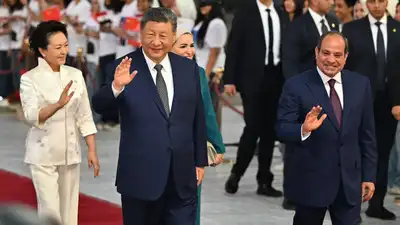
Chinese President Xi Jinping, second left, and his wife Peng Liyuan, left, are welcomed by Egyptian President Abdel-Fattah el-Sissi, right, and his wife Entissar Amer upon their arrival in Cairo
Egypt’s cabinet has said the Suez Canal Economic Zone has attracted around $4 billion in Chinese investment. On Wednesday, Egyptian authorities announced plans to expand a Chinese-developed industrial area in the zone, while ZC Rubber Group signed a preliminary agreement to study a $500 million tyre manufacturing complex.
Xi, on his first visit to the Middle East in four years, said countries in the region should be “masters of their own destiny” and explore a new regional “security architecture”, according to China’s state news agency Xinhua. The Chinese leader also said Beijing was ready to work with countries in the region to safeguard shipping routes, an issue that has gained greater significance after the conflict disrupted traffic through the Strait of Hormuz and Bab al-Mandeb. The two sides also agreed to expand cooperation in data centres, semiconductors and critical metals supply chains, while strengthening the use of their currencies in trade and investment, according to a joint statement. In talks with Sisi, Xi also said the two countries should jointly oppose what he described as “unilateralism and acts of bullying”, Xinhua reported, according to AP.
Chinese President Xi Jinping called on Middle Eastern countries to oppose external interference and consider reshaping the region’s security order during talks with Egyptian President Abdel Fattah al-Sisi in Cairo on Wednesday, as Beijing seeks to expand its influence amid the US war against Iran.
In an article published ahead of Xi’s visit, Sisi said Egypt was pursuing a policy of “strategic balance” at a time of increasing global rivalry. For Cairo, closer ties with Beijing form part of a broader policy of diversifying its international partnerships.
Pingback: Chinese President Xi Jinping, US President Donald Trump