The world’s most ancient stories depict humans (and often, animals) wandering, from the Greeks in the Iliad and Odyssey to Indians in the Ramayana and Mahabharata, discovering new landscapes and losing and finding their souls you to experience science firsthand.
John Huth is Donner Professor of Science in the Physics Department, Harvard University . Speaking with Srijana Mitra Das at Times Evoke , he discusses how humans navigate Earth — and social relations: What is the core of your research? My original research is in elementary particle physics, in particular, studying collisions of protons at very high energies. My work, the Atlas Experiment, is at the Large Hadron Collider where we discovered a particle called the Higgs boson. This was a missing piece in our standard model of particle physics — it gives mass to particles. I also study how humans navigate, the evolution of that and how that is manifest in diverse cultures. There exists a binary about how people view themselves in space — that led me to the evolution of concepts of space in science, from the ancient Egyptians to now. John Huth is Donner Professor of Science in the Physics Department, Harvard University What are foundational ways we see space? There are egocentric and allocentric notions of space. An egocentric notion is the way objects or landmarks are located relative to the person or ‘me’. Here, you might phrase directions as ‘go forward’ or back, left and right. The other notion is allocentric, where space exists on its own, not necessarily in reference to the individual. So, landmarks are relative to each other — you say, ‘Go north’, south, east or west. Cognitive psychologists indicate the way we perceive space is how we view social relations. So, you see people’s relationships to you as egocentric or allocentric, with you trying to figure out your own place. Has all that changed with GPS?
The word ‘mile’ comes from the Latin ‘mille passus’, which means a thousand paces through the mile, every time your left foot hits the ground being a pace. Because you’re doing useful things which give you a sense of uncertainties, etc, however, when you do non-instrument navigation, it’s you and the world — you’re already practicing science and this improves your relationship with it. She says, ‘Always keep the Big Dipper, the Great Bear, to your left as you sail’ — which means sailing east.
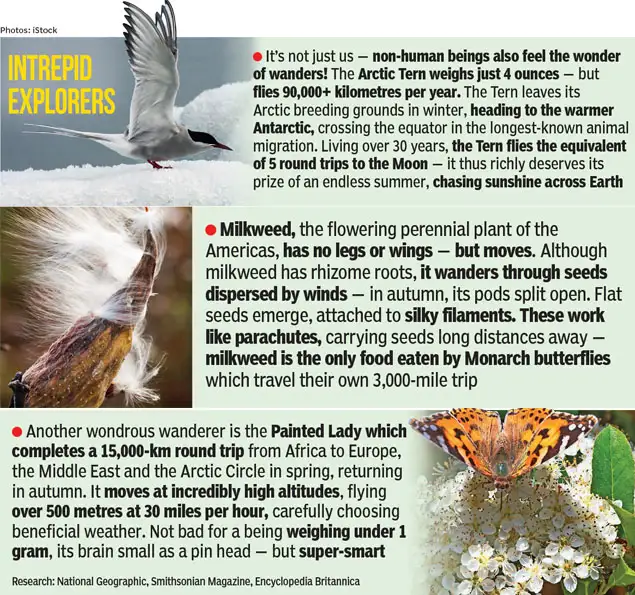
Yet, in ‘The Odyssey’, Odysseus gets entirely lost — what should we learn from his story? Before GPS and other technological methods of finding one’s way, you needed a map and worked out where you were on that — this representation of space is intrinsically allocentric. Now, if I seek my way with a cell phone, invariably, we are placed at the centre of that representation. Everything is relative to us — we lose a bigger view of the world. There’s a kind of adjacency which is not the same we experience in real life. You drift into this more egocentric realm where you aren’t perceiving the whole as a coherent, real thing. This directionality is causing problems. People are growing unable to see the bigger picture — that’s an issue for us collectively as a species. Constellations causing problems. In the ancient world, how did people figure out time, space and location? Time was often reckoned in terms of the positioning of the sun against a fixed background of stars. For example, there is the Pleiades star cluster, also called Matariki in Polynesian cultures. The setting of the Pleiades just after sunset, or just before sunrise, became a marker of time in seasons. You could also figure time by the passage of the sun in the sky — our clocks and timezones are designed to put the sun at the highest point in the sky, at noon. For space, people used elements like wind — this has different directions associated with it. Those bring the weather. In ancient Greece, for example, the north wind would bring cold weather while warm weather came from a wind from the south, helping people understand directionality. In the Marshall Islands, people used ocean waves to understand where atolls and islands were. Breeze carries weather Do non-human species work out location too? Yes. Now, the cataglyphis desert ant also counts its paces to find where it is — to orient itself, it sees the polarisation of the sun as a natural compass. So, by pacing and sun, this ant navigates. Birds use Earth’s magnetic field to navigate — yet, this is exceedingly weak. There are theories of a quantum mechanical way birds find Earth’s magnetic field. I even have a candidate molecule in mind towards that. These are just two of many different mechanisms animals use. Some have been studied closely — some are great mysteries. I’ve seen seagulls suddenly sit down in a cluster and face the same way. Clearly, they find a direction in the face perhaps of an approaching storm. Many species have different ways of figuring out time and space. Is mapping outer space versus local terrain different or similar? The egocentric and allocentric divide keeps coming up in our histories. If we posit humans at the centre of the uni-versity, as Aristotle or Ptolemy did, that’s an egocentric representation of outer space. With Copernicus or Kepler, where the sun was placed at the centre of the solar system, we get an allocentric take, not giving humans a privileged position. Now, this Copernican principle — humans are not at the centre — has expanded with the modern view of the universe, where we see galaxies receding at ever greater speeds, the farther away you get. By moving from an egocentric notion, we’ve reached the modern view of an expanding universe. Humans used the position of the sun to figure out time What does nature-based navigation show? I use this to teach science through a new perspective, where students learn to see all this stuff happening around them. Sometimes, science is perceived like there’s some expert out there who tells you something and you must take their word for it. In contrast, if you’re just fed science out of a paper or website, you rely on the expertise of another person. This allows you to experience science firsthand. Does it add a philosophical dimension to our understanding of ourselves? Yes, absolutely. It goes even beyond — it is actually the way our brain operates. The part of our brain responsible for a map of our surroundings is the hippocampus. Inside the hippocampus is the root of declarative memory — remembrances you can dig out. If I ask, for instance, about your favourite school teacher, you could probably conjure up their name. Declarative memory is willfully extracting a recollection. They are both in the same location. Now, if you look at how languages are organised, many spatial metaphors exist in a social domain — we may say, ‘They’re close’ or ‘They broke apart’, physical proximity a stand-in for intimacy. Or, we say, ‘I’ll talk to my higher-ups’, status and hierarchy linking with elevation or altitude. If you grow aware of metaphors between space and social relations, it’s difficult to go far into a conversation without tripping over these. Spatial organisation is intrinsically how our brains are planned to operate — space and navigation become metaphorically or physically related to how we think in other domains. Intrepid explorers You recall ancient ways of mapping. I view it as a social metaphor. Our ability to navigate our lives has a metaphoric relation to journeys. Homer used that. Interestingly, Odysseus lands on Calypso’s island and she gives him sailing directions to the Phaeacians. He travels thus and finally reaches. So, Calypso actually helps Odysseus find his way home. Catch the latest World News and Live updates. Download the TOI app.
Humans earlier employed pacing as a way of measuring distances.