
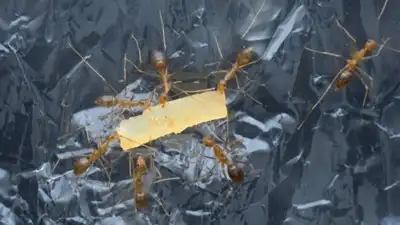
Can aluminium foil keep ants away from your kitchen? The viral hack explained
Ants finding their way into an Indian kitchen is a frustration nearly everyone’s dealt with; a single dropped grain of sugar seems to summon an entire trail within hours. So it’s no surprise that a viral hack claiming aluminium foil can keep ants at bay has been doing the rounds online, with videos showing foil balls, foil-lined shelves, and strips tucked along counters as a supposedly effective barrier. It’s cheap, it’s already sitting in most kitchen drawers, and the idea sounds plausible enough on the surface. But does the science, or even basic real-world testing, actually back this one up? Here’s a genuinely honest look at what’s really going on.
The most commonly cited explanation involves electromagnetic interference. Ants, like several other insects, are believed to navigate partly using the earth’s natural magnetic field, and since aluminium is a good conductor of electricity, the theory goes that a sheet of foil somehow disrupts that internal compass, confusing ants enough to steer them away from the area. It’s an interesting idea on paper, but even pest-control sources floating this explanation admit it remains a theory that needs considerably more research before anyone can call it proven. The second explanation making the rounds is more mechanical than electromagnetic: the idea that foil’s smooth, slippery surface simply doesn’t give ants enough grip to climb over or across it, functioning as a physical barrier rather than a chemical or magnetic deterrent. It’s the same logic behind smearing sticky barriers like petroleum jelly around plant stems to stop ants and other crawling pests from climbing up. Here’s where the hack starts to fall apart under real scrutiny. Gardeners who’ve specifically tested whether ants can climb bare aluminium foil report that they generally can, and quite easily. What looks perfectly smooth to the human eye is genuinely rough at a microscopic scale, and ants are already known to navigate surfaces like smooth PVC pipe and even Teflon without much trouble. Foil alone, without something genuinely sticky layered on top of it, doesn’t appear to hold up as the clean physical barrier the hack claims it to be. The more credible ant-fighting benefit of foil has nothing to do with the material repelling ants directly and everything to do with cleanliness. Pest-cleaning experts have specifically flagged the narrow, hard-to-reach gap between a stove and adjacent cabinets as a magnet for crumbs, grease, and food debris, exactly what draws ants and other pests into a kitchen in the first place. Lining that space with foil doesn’t repel ants through some special property; it simply makes cleanup dramatically easier, removing the food source ants are actually chasing rather than the ants themselves. Outdoors, aluminium foil does have somewhat more credible backing as a general pest deterrent, though again, not specifically for ants. Reflective foil placed around garden beds or worked into mulch can confuse and repel various flying and light-sensitive insects by bouncing sunlight unpredictably as it shifts in the breeze. That’s a different mechanism and a different set of pests than the kitchen countertop version of this hack, and it isn’t strong evidence that foil does much to stop ants specifically walking across a surface. Based on everything currently available, aluminium foil isn’t a proven, reliable way to keep ants out of your kitchen on its own. If you’re dealing with an active ant problem, you’re better off combining proven methods, sealing entry points, wiping up spills and crumbs promptly, and trying genuine deterrents like vinegar, cinnamon, or citrus, rather than counting on a sheet of foil to do the heavy lifting. Where foil genuinely helps is in the cleanup itself, making those awkward gaps behind appliances easier to keep crumb-free in the first place. This article is intended for general informational purposes only and is not a substitute for professional pest control advice. The effectiveness of aluminium foil as an ant deterrent is not scientifically well-established, and results may vary. For persistent or large-scale ant infestations, consult a licensed pest control professional. Looking for trusted parenting advice? Follow TOI Parenting Circle on Instagram for expert guidance, relatable stories, and practical tips delivered every day.