
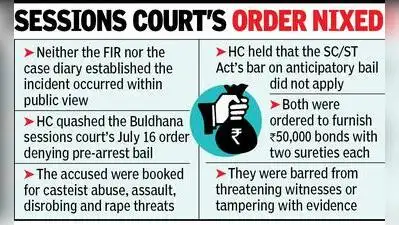
Sessions Court’s Order Nixed
The FIR was registered at Chikhli police station on June 30 after a complaint by a 23-year-old woman. She alleged that she and her mother were working in their agricultural field around 11.30am when both accused abused them, hurled caste-based slurs and assaulted them with an iron rod.
The court ultimately held that no bar under Section 18 of the SC/ST Act prevented the grant of anticipatory bail and described the trial court’s refusal to release the two accused as “unjustifiable”. The prosecution also alleged that the accused pulled the complainant’s saree and threatened to rape her. The prosecution opposed the appeal, pointing to one of the accused’s five to six criminal cases and preventive proceedings registered at Chikhli police station. HC noted, however, that he had already been granted bail in those matters.
They challenged the July 16 order of Buldhana sessions court, which rejected their anticipatory bail application.
The case diary, the court said, contained no indication that any third person witnessed the alleged remarks. Nagpur: The Nagpur bench of Bombay high court recently granted anticipatory bail to two men accused in a case under the Scheduled Castes and Scheduled Tribes (Prevention of Atrocities) Act, holding that neither the FIR nor the case diary showed that the alleged casteist remarks were witnessed by the public. The court was hearing an appeal by two farmers from Buldhana district. HC quashed the order. The court relied on Supreme Court judgments explaining the distinction between a public place and a place within public view. It noted that the statutory bar on anticipatory bail under the SC/ST Act applies where the complaint makes out a prima facie case attracting the Act, including the relevant requirement concerning public view.