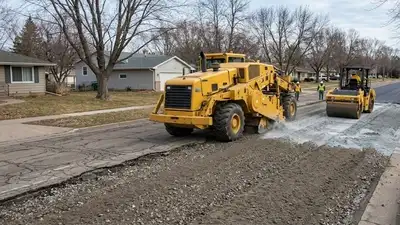
AI-generated representative image showing an old road being pulverized and stabilized with coal fly ash during a full-depth pavement reclamation project. Credits – Gemini
Instead of ripping out the old asphalt and replacing it with a new aggregate foundation, a road reclaimer pulverised the previous pavement and base material to a depth of approximately 300 millimetres, creating what researchers refer to as recycled pavement material, or RPM. Crews added Class C fly ash to the recycled material at 10% of the dry weight during construction in 2004, according to the University of Wisconsin-Madison project report. After seven days of curing, laboratory-prepared stabilized material had a resilient modulus of 78 to 119 MPa, compared with roughly 46 to 50 MPa for untreated recycled pavement material. Measurements at Waseca in August 2005, about one year after construction, indicated no degradation in the modulus of the stabilized recycled pavement material after it had been exposed to a winter freeze-thaw cycle. The two sets of field measurements exhibited mean moduli of roughly 262 and 252 MPa, respectively, and statistical testing showed no significant difference between them. The resilient modulus of fly ash-stabilized road-surface gravel dropped by approximately 17% after five laboratory cycles, while the recycled pavement materials examined saw reductions from about 25% to 42%, according to the University of Wisconsin-Madison and Minnesota transportation study report. In a larger collection of stabilised materials, reductions after 12 cycles were no greater than 50%. The engineers broke up the existing road, added 10% Class C fly ash and compacted the mixture into a new base.
Therefore, the recovered pavement material has a significantly stronger, stiffer structure than the untreated material alone.
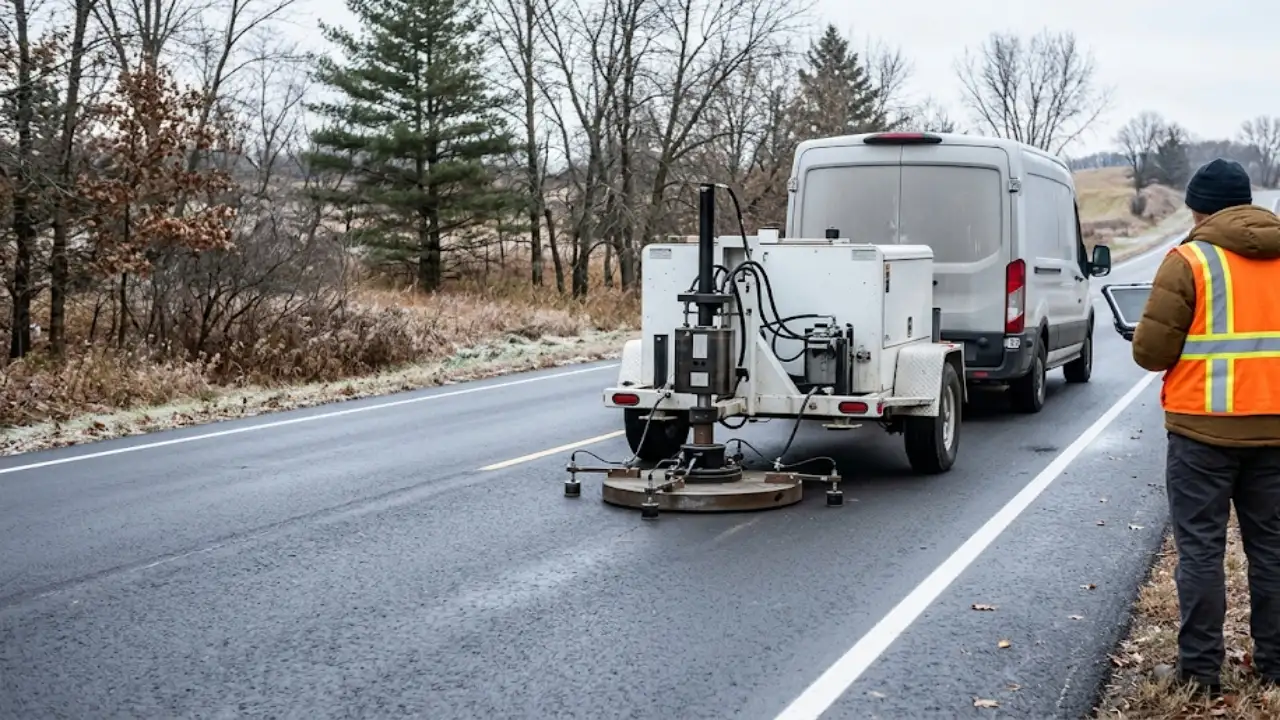
“There were no established criteria specifically for resilient-modulus testing for fly ash-stabilized materials,” the paper said. “Longer-term monitoring will be needed to understand leaching over the complete service life of the pavement,” the researchers added. It’s not always necessary to remove all that already exists to rebuild a road. Engineers in Waseca, Minnesota, experimented with a more circular strategy: they ground up the old pavement, strengthened the recycled material with coal fly ash, and then replaced it with a fresh asphalt covering. As part of a Minnesota study investigating whether fly ash could stabilise recycled pavement material sufficiently to function as a new road basis, the experiment was conducted on 7th Street and 7th Avenue. Particularly after the restored area experienced its first Minnesota winter, the outcomes were positive. Researchers found that the stabilised layer was stiffer and stronger than the untreated recycled pavement material. Field observations post-freeze-thaw cycle likewise showed no degradation of its modulus, and the researchers noted that they needed a longer period of monitoring. What was done on 7th Street and 7th Avenue This process is called full-depth reclamation. During mixing, water was added; the material was compacted one to two hours after mixing, and the stabilised layer was cured for seven days before a fresh hot-mix asphalt surface was placed. Self-cementing Class C fly ash is characterised by a chemical composition that enables it to react with water and generate cementitious products. How the researchers tested it The researchers didn’t just rely on one assessment of the pavement. In the field, a soil stiffness gauge and a dynamic cone penetrometer were used, while in the laboratory, tests for resilient modulus, California bearing ratio and unconfined compressive strength were conducted. The case study found that adding fly ash substantially improved the bearing resistance and stiffness of the recycled pavement material. The key test was made after construction. Researchers employed a falling-weight deflectometer to evaluate the stiffness of the underlying layers by applying a controlled load to the pavement and measuring the subsequent deflection. This was important since pavement bases are particularly susceptible to damage from freeze-thaw action. If water gets into the substance, it can freeze and expand and then weaken the layer when the temperature rises again. A stabilised base that remains rigid after winter has a significant advantage over a weaker, untreated layer. The numbers that make the narrative complicated The Waseca field result should not be interpreted as indicative of the fact that fly ash-stabilized pavement is immune to any freeze-thaw exposure. In the larger Minnesota investigation, the stabilised materials were subjected to numerous laboratory freeze-thaw cycles and response was found to be dependent on the base material. The gap between the field and laboratory data is significant. In Waseca, pavement field stiffness did not change after one winter, while lab specimens subjected to repeated, controlled freeze-thaw cycles had noticeable losses. The researchers suggested continuing monitoring in the field rather than using the first winter as evidence of permanent durability. Testing has its limits as well. Taking undisturbed samples from a stabilised pavement could damage the samples and affect the results. The environmental question At the Waseca site, drainage was captured in a lysimeter placed under the roadway, allowing the researchers to analyse the chemical composition of the drainage. The assessment found that the detected trace elements remained below US Environmental Protection Agency maximum contaminant levels; manganese, however, exceeded the Minnesota health-risk level cited in the report. That finding qualifies the engineering achievements in an important sense. The use of an industrial by-product can reduce the demand for fresh aggregate. However, the material still needs to be examined for both uniformity and environmental behaviour. AI-generated representative image showing a falling-weight deflectometer measuring pavement stiffness on a rehabilitated roadway. Credits – Gemini What does that mean The Waseca experiment demonstrated that an old pavement can be part of its replacement. The stabilized layer had substantially greater stiffness and strength than the untreated recycled material. The first winter looked promising: field deflection tests showed no significant change in pavement modulus after freeze-thaw exposure. Laboratory tests, however, showed that repeated freeze-thaw cycles could reduce stiffness in some stabilized materials, while environmental monitoring identified manganese as a separate issue requiring attention. The practical lesson is narrower: the results suggest that fly ash stabilization can strengthen recycled pavement material under the conditions tested. Fly ash stabilisation can be an effective base for recycled pavement and reduce the need to remove existing road material under the conditions evaluated, the results suggest. Rather than assuming the method would perform identically elsewhere, the researchers measured the material, monitored the pavement through winter and examined the drainage. You use AI every day. Now get your AI Quotient. Take the AIQ test.