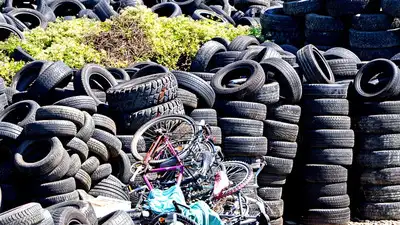
Tire piles waiting for recycling. Image credits: Wikimedia Commons
The Integrated Road Research Facility (IRRF) at the University of Alberta, founded in 2012, describes its test road as unique in Canada. The road links the Edmonton Waste Management Centre with Anthony Henday Drive (Highway 216). The road was built with scrap tyres and waste bottom ash and carries more than 250 geotechnical, environmental and pavement sensors, whose data an automated system sends over the Internet to the university laboratory. The IRRF project description states that more than 8,000 tonnes of recycled tyres, about 825,000 scrap tyres, were processed into tyre-derived aggregate and used to build the road. The IRRF reports that building the road diverted these tyres from Edmonton’s landfill and saved approximately 103,123 m³ of landfill space. The first published field results came from Negar Tavafzadeh Haghi and colleagues in Using Field Data to Evaluate Bottom Ash as Pavement Insulation Layer , which appeared in Transportation Research Record in 2014. Instrumentation took place at various depths in Edmonton, Alberta, and frost depth, freezing, and thawing duration were evaluated using temperature data from October 2012 to June 2013, according to the paper. From the field data, the authors estimated thermal resistivities (R-values) of 1.4 m²°C/W for bottom ash and 16.7 m²°C/W for polystyrene, and the insulation layers reduced frost depth by at least 28% and 40%, respectively, compared with the control pavement section. Frost depth cut by 24% with bottom ash and 64% with polystyrene in the 2021 study Yunyan Huang and colleagues revisited the road eight years after construction in Performance Evaluation of Different Insulating Materials using Field Temperature and Moisture Data , published in Transportation Research Record in 2021. The study took measurements on three 20 m insulated segments and one control segment. Field temperature and moisture gauges were used to compare the 100 cm bottom ash layer with the 10 cm polystyrene board. It was found that the maximum frost depth for the control segment was 2.10 m, 1.60 m with bottom ash, and 0.75 m with polystyrene insulation, a decrease of 24% and 64%, respectively.
The same description lists three main research areas: tyre-derived aggregate and tyre-soil mixtures as embankment materials, flexible pavement performance in cold weather, and insulated pavement sections using polystyrene boards, bottom ash and tyre-derived aggregate.