
IIT-Gn Study
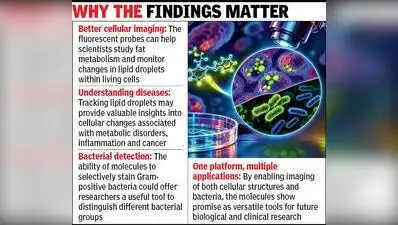
Experts said the distinct glow produced by the molecules under a microscope could support future clinical and biological research. The study examined three molecules based on a compound called cyanostilbene, according to the researchers. Researchers said the probe could be used to study changes in lipid droplets linked to inflammation and cellular stress.
Ahmedabad : As Diwali celebrates light and new beginnings, researchers at IIT Gandhinagar (IIT-Gn) have brought illumination to the microscopic world by developing a set of fluorescent molecules that can track fat-storage structures inside human cells and identify specific bacteria. The study, titled ‘α-Cyanostilbene fluorophores as versatile dual-function imaging agents: from imaging lipid droplet dynamics in live cells to selective Gram-positive bacterial detection’, was conducted by Gayatri Bhattad, Deeksha Rajput, Achintya Jana, Abhijit Mishra and Sriram Kanvah, and has been published in the journal Organic and Biomolecular Chemistry. The molecules contain different chemical groups and exhibit a property known as aggregation-induced emission (AIE). Unlike conventional fluorescent dyes, which tend to lose brightness when they accumulate, these molecules become brighter when clustered together. One molecule, P3, showed particularly promising results. It produced stronger fluorescence and remained attached to lipid droplets for more than six hours. The findings highlight the potential of these fluorescent probes as versatile tools for biological research, enabling scientists to study both lipid-droplet dynamics in living cells and differences among bacterial groups using a single imaging platform. You Can Also Check: Gold Rate in Ahmedabad | Silver Rate in Ahmedabad | Bank Holidays in Ahmedabad | Public Holidays in Ahmedabad | Ahmedabad AQI | Weather in Ahmedabad | Petrol Price in Ahmedabad | Diesel Price in Ahmedabad | CNG Price in Ahmedabad | LPG Price in Ahmedabad