
.
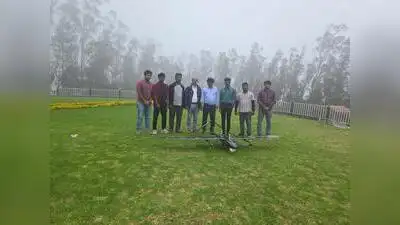
Chennai: The Centre for Aerospace Research (CASR) at Anna University has successfully completed a Beyond Visual Line of Sight (BVLOS) drone flight at an altitude of 2,500m at Doddabetta in the Nilgiris, covering 175km at a speed of 65kmph.
“Operating at 2,500m in the Nilgiris was demanding because of thinner air, variable winds and rapidly changing weather conditions,” said K Senthil Kumar, director, CASR. The flight had a loiter radius of 300m. BVLOS refers to the operation of an unmanned aircraft beyond the unaided visual range of the remote pilot.
“The aircraft remained stable and the control and communication systems performed reliably throughout the flight. To our knowledge, this is the first such demonstration at this altitude. The data collected will help us refine endurance, payload and safety parameters for the next phase,” he added.
Doddabetta Peak (2,637m above sea level) is the highest point in the Nilgiris. The mountainous terrain also helped them to validate geofencing, return-to-home and lost-link procedures under demanding conditions. You Can Also Check: Gold Rate in Chennai | Silver Rate in Chennai | Bank Holidays in Chennai | Public Holidays in Chennai | Chennai AQI | Weather in Chennai | Petrol Price in Chennai | Diesel Price in Chennai | CNG Price in Chennai | LPG Price in Chennai Stay updated with the latest Chennai news.
Researchers said the peak’s elevation provided an extended radio horizon, making it suitable for testing command-and-control and telemetry links over long distances. “This test could pave the way for medical and emergency supply delivery, including blood and medicines, to remote hill habitations, besides power-line and pipeline inspection, forest and wildlife monitoring, disaster response and large-area mapping,” Senthil Kumar said. The high-altitude location enabled the team to assess impact of reduced air density on propeller thrust, motor efficiency, endurance and payload capacity. Cool temperatures, humidity, fog, strong winds and rapidly changing weather also provided realistic conditions to examine the drone’s batteries, thermal management systems and sensors. The trials were conducted in a designated Green Zone in accordance with Directorate General of Civil Aviation (DGCA) guidelines. The project was undertaken under the BVLOS initiative sanctioned to CASR by the Tamil Nadu Innovation Initiative (TANII), in association with the Tamil Nadu Industrial Development Corporation (TIDCO). University registrar (in-charge) V Kumaresan congratulated the team. The researchers also thanked the Nilgiris district administration for its support. CASR and its partners will conduct further high-altitude and long-distance trials, integrate medical payload delivery and work towards operational drone-based emergency medical support for remote regions. Download the TOI App.