
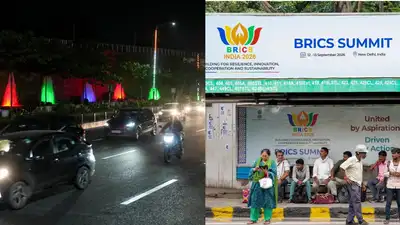
Delhi traffic will face unpredictable disruptions during the BRICS Summit
The traffic plan announced ahead of the September 11-13 BRICS Summit at Bharat Mandapam covers more than 35 roads and 22 diversion points, with nearly 4,800 traffic personnel deployed for the arrangements. Vehicles may be held temporarily or diverted depending on security requirements and the ground situation, before being released in phases, news agency PTI reported.
But there is no fixed duration for traffic stoppages during VVIP movements, the traffic police said. NEW DELHI: Delhi will not be shut down during the BRICS Summit, but for commuters, the bigger worry may be the uncertainty on the roads: a route that is open one minute could be stopped or diverted the next when a VVIP convoy approaches. For Delhi-NCR commuters, that could mean that simply checking whether a road is officially closed may not be enough. A regular route could remain open for most of the day but face sudden restrictions when a convoy moves through it.
The Delhi Traffic Police on Thursday clarified that normal traffic will continue wherever security arrangements permit, even as restrictions are imposed in notified controlled areas and on routes used by foreign delegations and dignitaries.
Noida, Dwarka, airport commuters could feel the ripple effect
Earlier reporting noted: Traffic movement is expected to be affected across more than 35 roads, with 22 diversion points identified by the Delhi Traffic Police. For daily commuters, students and people travelling to transport hubs, hospitals or examination centres, even a short VVIP stoppage could therefore have a knock-on effect on the rest of their journey. Traffic police have coordinated with online map service providers so that restrictions, diversions and alternate routes can be incorporated into navigation platforms in real time. For commuters, therefore, the challenge over the next few days may not be navigating a city-wide shutdown, but navigating a city where traffic conditions can change with every VVIP movement.
Traffic may instead be stopped briefly for a convoy and then released in phases. This could make journey times difficult to predict, particularly for people travelling during peak office hours or those who have fixed reporting times, PTI reported. Inter-state buses may also face temporary changes in routes, entry points or termination points, PTI reported.
The traffic police has also cautioned commuters against forwarding unverified social media messages claiming that Delhi will observe a “bandh” or that there will be blanket road closures. With the summit bringing multiple delegations and potentially dozens of high-security movements each day, the question for a commuter may be less “Is my route closed?” and more “Will my route remain open by the time I reach it?” (With agency inputs) You Can Also Check: Gold Rate in Delhi | Silver Rate in Delhi | Bank Holidays in Delhi | Public Holidays in Delhi | Delhi AQI | Weather in Delhi | Petrol Price in Delhi | Diesel Price in Delhi | CNG Price in Delhi | LPG Price in Delhi Stay updated with the latest Delhi news. Each movement requires traffic regulation and route coordination, meaning the impact could spread well beyond the immediate VVIP corridor. Commuters travelling between Noida and central Delhi, east Delhi and central areas, as well as those travelling from Dwarka and west Delhi towards Dhaula Kuan, the airport and south Delhi, are among those likely to be affected. As highlighted in the traffic plan, restrictions around central Delhi can push vehicles onto connecting roads, creating congestion even on stretches that are not themselves under a complete restriction. Check your route first before planning your travel The movement of the Egyptian delegation between its hotel in Saket and central Delhi could add to pressure on south Delhi roads during peak hours. The issue for commuters is not necessarily that an entire road will remain closed. During that period, vehicles can accumulate behind the restriction, while diverted traffic adds pressure to alternative routes. Candidates appearing for UPSC, NDA, CDS and other examinations have been advised to check their centres and routes beforehand, carry their admit cards and identification and leave sufficiently early. People travelling to hospitals for planned appointments have also been advised to allow additional time and check their routes in advance. In a genuine medical emergency, commuters have been asked to immediately inform nearby traffic personnel. The Delhi Metro will continue to operate during the summit, although temporary restrictions could be imposed at some stations or entry and exit gates if required for security reasons. DTC and city buses will also operate, but routes passing through affected areas could be diverted, curtailed or regulated. Autos, taxis and app-based cabs will continue to operate, but their movement into controlled areas and pick-up and drop-off arrangements could be affected. Delivery services may similarly face restrictions in controlled areas, while movement of essential supplies such as milk and medicines will be facilitated under the applicable arrangements. Cab aggregators have also been advised against keeping pick-up and drop-off points inside restricted or controlled areas during VVIP movements. Heavy vehicles and trucks could face special restrictions on entry timings and routes and have been advised to check notified routes before travelling. Residents living in notified controlled areas will not be completely barred from movement. They will be allowed to move subject to security arrangements and have been advised to carry valid identification and address proof and follow directions from police personnel. Parking on restricted and security-sensitive roads will not be permitted, with motorists advised to use designated parking facilities. The police has asked people to rely only on official traffic updates. Download the TOI App. Restrictions will be implemented depending on the movement of VVIP convoys and security requirements. How will public transport be affected? Metro services, however, are expected to operate as usual and may be the preferred mode of transport for commuters.
Traffic police had earlier suggested shifting the delegation’s accommodation closer to central Delhi to minimise the impact on traffic. Earlier reporting noted: How will public transport be affected? Earlier reporting noted: Buses, autos and taxis are likely to face diversions and delays during VIP convoy movements.
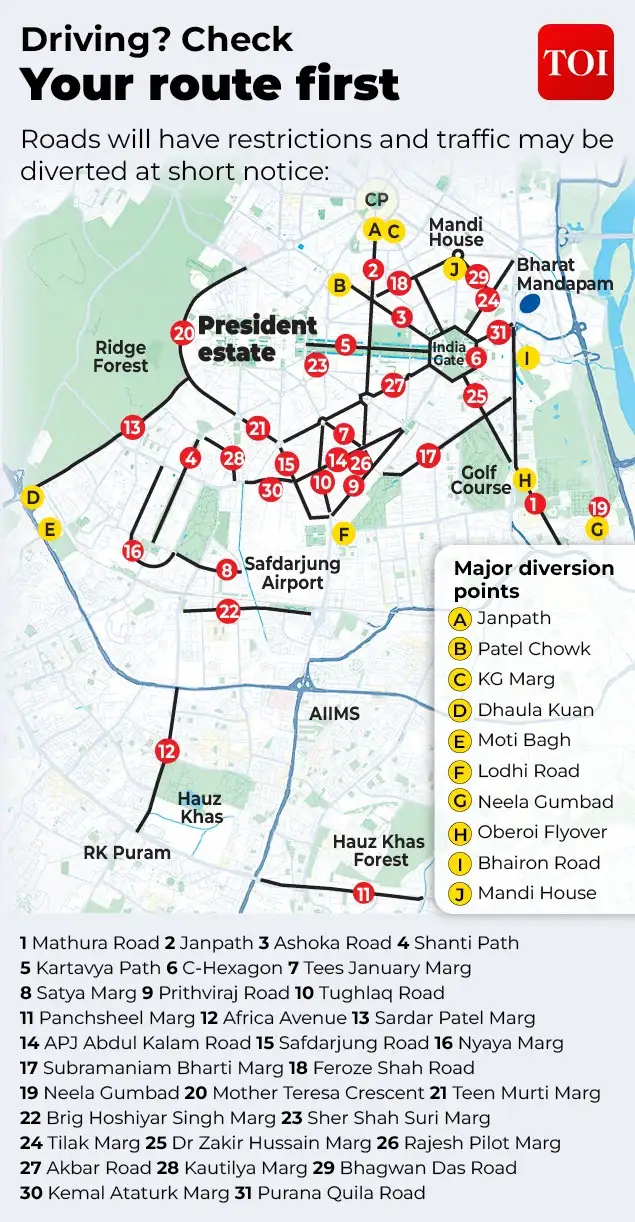
The restrictions are expected to remain in force from September 10 to around September 14. Officials estimate that these could add up to 70-80 or more high-security movements across the city in a single day, PTI reported. Thursday’s advisory makes clear that the disruption during the summit could vary depending on the movement of individual delegations While Wednesday’s motorcade rehearsal gave commuters a preview of the congestion that can result from such arrangements. A visiting leader could have several high-security movements in a single day, from the airport to the hotel, the summit venue and then to bilateral meetings or other official engagements.
Pingback: Check your route first before planning your travel More than 35 roads could see